John the Baptist and the Reliquary of ‘Sveti Ivan’ : Methodological Reflections

15 June 2012

This article is a slightly revised (June 2012) version of a post published here in August 2010, at the time of the initial press release. Fortunately, the most recent press reports (June 2012) are more circumspect and cautious than those of two years ago. Furthermore, please allow me to emphasize here that these excavations are useful and impressive, with some significant archaeological material culture having been excavated. Nevertheless, the conclusion must still be that there is no good evidence to suggest that these bones are probably those of John the Baptist.

_

I. Summary of the Salient Details of the ‘Sveti Ivan’ Excavation and the Claims regarding the Reliquary

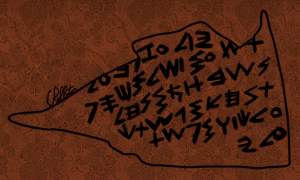
A portion of a small island known as ‘Sveti Ivan’ (a Bulgarian term that means “Saint John”) has been the site of excavations for a number of years. This island is located in the Black Sea, about a kilometer from the Bulgarian town of Sozopol, one of the oldest on Bulgaria’s southern coast. Kazimir Popkonstantinov is the director of the excavations on Sveti Ivan. Aerial images reveal that there are (at least) two prominent sets of monumental archaeological remains on the island. These have been affirmed to be the remains of: (1) a church of ca. the 6th century CE; (2) and a monastery (and church) of ca. the 13th and 14th centuries CE.

Under the ruins of the 6th century church are the remains of an older basilica, and these older remains have been dated to ca. the 5th century CE. It was in the ruins of this older basilica that a reliquary was found. (1) The reliquary’s measurements are ca. 20.5 cm. x 12.5. cm. x. 14.5 cm. The reliquary is reported to have been made of alabaster. Within this reliquary were found bone fragments (six human bones and three animals bones), and the human bones included portions of a skull, a hand, a tooth, a rib, and an arm bone. (2) Near the reliquary was a small sandstone box measuring ca. 4 cm. x 6 cm. On this small sandstone box is a Greek inscription that reportedly says “May God save you, servant Thomas. To Saint John, June 24.”

Popkonstantinov had stated (in 2010) that the inscription is the “key” to the interpretation of the finds. That is, based on this inscription, he has stated that the remains found in the alabaster reliquary may very well be those of John the Baptist, a figure of the Greek New Testament.

II. Summary of the Salient Features of the Greek New Testament’s Statements regarding John the Baptist

Although New Testament scholarship has cogently argued for more than a century that the New Testament documents are not historical in all of their details, it has been argued convincingly that certain things can be known about John the Baptist with a high degree of historical certainty. Namely, (1) He was a Jewish Apocalypticist of the 1st century CE; (2) He was connected in some fashion with a movement surrounding Jesus of Nazareth; (3) John the Baptist was imprisoned in the Galilee by Herod Antipas (note: Herod was the Tetrarch of Galilee and Perea from ca. 4 BCE to ca. 39 CE). (4) John was martyred by Herod Antipas, arguably some time between 26 CE and 30 CE. (5) John had followers (referred to in Greek as mathetai) and these followers buried John the Baptist after he was killed, arguably (according to the Marcan tradition), in a tomb (for these details, see Mark 6:14-29; Matt 14:1-12; Luke 9:7-9; for the birth narratives of John the Baptist, see Luke 1; for his apocalyptic message, see Mark 1:2-8; Matt 3:1-12; Luke 3:1-20). (6) Josephus has some material about John, but this material does not alter the details about John the Baptist that I have noted here.

III. A Critique of Popkonstantinov’s (2010) Arguments, and any similar arguments made now in 2012

1. John the Baptist was buried in a tomb in Palestine, arguably in the Galilee (where he died). (2) John the Baptist died during the early 1st century CE. Therefore, without some compelling evidence for the moving of the body (or portions thereof) of John the Baptist (centuries later!) from the place of burial in Palestine, it is not cogent or prudent to propose that the remains found on a small island in the Black Sea, in the archaeological ruins of a basilica of the 5th century CE, are those of a Palestinian Jews named John the Baptist who lived, died, and was buried in the 1st century CE, in Palestine.

3. To be sure, Popkonstantinov has argued (2010) that the inscription on the sandstone box near the reliquary is the “key” to his interpretation. However, this is not particularly convincing. After all, the inscription certainly does *not* state that “these are the remains of John the Baptist.” 4. The date of June 24th is one of the feast days for John the Baptist (e.g., within Orthodox Christianity), but this cannot be construed as evidence that the bones themselves are actually those of John (indeed, the date of the founding of this church would argue against this, as the church was founded centuries after the death and burial of John the Baptist). 5. Furthermore, the inscription is not on the reliquary (where the bones were found), but rather, they are on a sandstone box that was found *near* the reliquary. One might propose that the bones are those of a certain man named “Thomas,” but even this is not necessarily the case, for a number of reasons (not the least of which is the fact that the reliquary and sandstone box need not have belonged to the same person or been deposited at precisely the same time in the basilica).

6. Mostly, the inscription strikes me as a plea of a pious believer from the island of Sveti Ivan to a famed patron saint, namely, a plea to John the Baptist. That’s it. That’s the way I would interpret the totality of the evidence.

7. Note that Popkonstantinov had stated (2010) that he knew of no DNA database for the relatives of John the Baptist. This is correct…there is certainly *not* such a database of DNA data for the relatives of John the Baptist. 8. Of course, carbon tests have recently been done on three of the human bone fragments, and these are ostensibly helpful in establishing the basic chronological horizon for the interred remains (assuming they have not been handled so much that carbon dating will be very difficult or almost impossible), but even these sort of data can do no more than suggest that these bones came from the same basic chronological horizon as John the Baptist. That’s a far cry from demonstrating that these are the actual bones of John the Baptist.

Ultimately, I would contend that for someone to suggest that these bones could be those of John the Baptist, a figure of 1st century CE Palestine, is tenuous in the extreme. In this connection I should note that Popkonstantinov (knowing that his understanding of the evidence is strained to the breaking point) was quoted as saying (in 2010): “Here, I believe, the science stops. Since we cannot prove the attribution of any of the relics with scientific methods, we have to be tolerant of those who want to believe that they are” (Popkonstantinov). I would gently suggest, though, that archaeological and literary analyses are about evidence, not about authority, faith, or piety. Thus, with all due respect, it is necessary to state that Popkonstantinov’s conclusions do not follow from the evidence.

IV. For the Sake of Argument, Here are the Sort of Data that would be Needed for Popkonstantinov’s Case.

1. A reliable ancient tradition, preferably from the late(r) 1st century or very early 2nd century CE, stating that the bones of John the Baptist had been moved to an island in the Black Sea; 2. An inscription on the burial box that stated something like “The bones of John the Baptist” (i.e., name and title…something such as “John” would not be sufficient); 3. A palaeographic date for the inscription itself that was late 1st century or very early 2nd century (after all, arguably no one in later centuries would be able to locate precisely the burial site of John the Baptist in Palestine and it may be that even in the late 1st century no one would have been able to have done so!). (4) Carbon 14 dating of the bones that yielded a 1st century CE date. We now have a carbon date which is helpful, but without the other data just outlined above (numbers 1-3), the carbon dates cannot be considered particularly useful in identifying the remains, even if they do come from the same basic chronological horizon. 5. Thus, in light of the general dearth of necessary data, it is necessary to conclude that these bones are not those of John the Baptist himself.

Sincerely,

Christopher Rollston

Review of The Jesus Discovery: The New Archaeological Find that Reveals the Birth of Christianity, by James D. Tabor and Simcha Jacobovici (New York: Simon and Schuster, 2012).

12 April 2012

INTRODUCTION

Alas, Tabor and Jacobovici’s monograph is replete with a superabundance of problems. Within this review, I will confine my discussion just to (some of) the major problems. Nevertheless, this review is quite long, something demanded by the problematic content of the volume itself. For this reason, readers may wish to scan for highlighted headings within the review so as to find the areas of critique in which they have the most interest. I should like to mention that much of the content of this review was first presented on the Official Blog of the American Schools of Oriental Research. Finally, I should like to emphasize that although I have attempted to document the secondary references quite well, it was not feasible to refer to all of the contributions that all scholars have made. Nevertheless, I have attempted to refer to as many of the primary contributors as possible.

I. SYNOPSIS OF THE ESSENCE OF THE VOLUME

Here are the basic claims of Tabor and Jacobovici. “Talpiyot Tomb B” contained several ossuaries, or bone boxes, one of which had some interesting ornamentation, one of which had a four-line Greek inscription, and one of which had the Aramaic word “mara” written in Greek letters. Taken together, Tabor and Jacobovici argue that the ornamentation and the inscription constitute “the earliest archaeological evidence of faith in Jesus’ resurrection.” They go on and state that these ossuaries “also provide the first evidence in Jerusalem of the people who would later be called ‘Christians.’ In fact, it is possible, maybe even likely, that whoever was buried in this tomb knew Jesus and heard him preach.”

In addition, Tabor and Jacobovici claim that because “Talpiyot Tomb B” is within around two hundred feet from “Talpiyot Tomb A” (the tomb Tabor and Jacobovici have also dubbed the ‘Jesus Family Tomb’) “the new discovery [i.e., “Talpiyot Tomb B”] increases the likelihood that the ‘Jesus Family Tomb’ is, indeed, the real tomb of Jesus of Nazareth.” Tabor and Jacobovici also believe that “Jesus of Nazareth was married to Mary Magdalene and had a son named Judah,” something which they have been proposing for several years now. Tabor and Jacobovici also assume that “both tombs appear to have been part of the property of a wealthy individual possibly Joseph of Arimathea, the man who, according to the gospels, buried Jesus.”

At this juncture, I shall turn to a fairly detailed discussion of both tombs and the contents thereof. Suffice it to say that I am confident most scholars will not consider the grand claims of Tabor and Jacobovici (as enshrined in the title of the book) to be cogent. The reason is quite elementary: the conclusions they draw do not follow from the extant evidence.

II. OLD NEWS: ‘TALPIYOT TOMB A’ (TALPIYOT TOMB 1980)

This tomb was discovered in 1980 by Yosef Gath during a salvage excavation at a site in the neighborhood of East Talpiot, Jerusalem. I shall refer to it as Talpiyot Tomb 1980 because of the year of its discovery. It contained ten ossuaries, six of them inscribed. These were subsequently published in Rahmani’s A Catalogue of Jewish Inscriptions (1994, nos 701-709). The personal names on the ossuaries of this tomb are as follows: (1) Mariamē kai Mara (Mariam and Mara). (2) Yhwdh br Yšw‘ (Yehudah bar Yeshua‘). (3) Mtyh (Mattiyah). (4) Yšw‘ br Yhwsp (Yeshua‘ bar Yehosep). (5) Ywsh (Yoseh). (6) Mryh (Maryah). The names Yehosep, Yoseh, Yeshua‘, Yehudah, Mattiyah, Maryah, Maryam, Mariamne, Mara and Martha (or the variants thereof) all have multiple attestations in the multilingual corpus of ossuaries and some are very common (Rahmani 1994, 292-297; Ilan 2002). In fact, even the name and patronymic “Yeshua‘ bar Yehosep” (i.e., “Jesus son of Joseph”) is not unique in the epigraphic corpus. After all, some eighty years ago, Sukenik published an ossuary inscribed “Yeshua‘ son of Yehosep” (“Jesus son of Joseph”) and the names Yeshua‘ and Yehosep (“Jesus” and “Joseph”) are predominant in the family of Babatha’s first husband. In fact, the father of Babatha’s first husband was named Yeshua‘ and his father was named “Yehosep,” so this is yet another “Yeshua‘ son of Yehosep” (i.e., “Jesus son of Joseph”; see Sukenik 1931; Lewis 1989, 35-40; cf. Yadin 1971, 233-234; Kraeling 1946, 18-19). Thus, even with the small corpus of epigraphic attestations of personal names, the Talpiyot Tomb 1980 occurrence of “Yeshua‘ bar Yehosep” (“Jesus son of Joseph”) is not even unique.

It is certainly true that filmmaker Simcha Jacobovici, along with Charles Pellegrino, James Tabor, and Andrew Feuerverger attempted to argue that this was the family tomb of Jesus of Nazareth (Jacobovici and Pellegrino 2007; Tabor 2006; Feuerverger 2007). But the epigraphic evidence (such as personal names) from this tomb does not support their contention, neither does the DNA evidence, nor does the statistical evidence. Indeed, a cross-section of scholars (including Eric Meyers, Shimon Gibson, Jodi Magness, Sandra Scham, and I) wrote articles several years ago in the academic journal Near Eastern Archaeology (published by the American Schools of Oriental Research) arguing that the cumulative evidence certainly did not support the view that this Talpiyot tomb was the tomb of Jesus of Nazareth or his family.

In addition, I should also emphasize that Tabor and Jacobovici’s desire to state that the Ya‘akov Ossuary (often called the “James Ossuary,” especially by those who wish to say this ossuary was not tampered with epigraphically and that it is Christian) came from Talpiyot Tomb 1980 is speculative (and I would also note in this connection that the patina of stone ossuaries from the same quarry which were housed in the same basic environment in a Jerusalem tomb will, of course, share certain many chemical features…so even patina evidence is of no great value. I will be happy to talk more about this later, should the need arise).

It is important to remember this dictum: Dramatic claims require dramatic evidence. And ultimately the strong consensus of scholars working in the fields of ancient epigraphy, archaeology, and ancient religion was then, and is now, that Talpiyot Tomb 1980 is not that of the family of Jesus of Nazareth. That is, the dramatic claims of Tabor and Jacobovici could not be embraced previously (i.e., 2007) because the evidence simply was not there. I am happy to resurrect this discussion, but the claims of Tabor and Jadobovici for this tomb are no more convincing now than they were then.

III. NEW TOMB, NEW CLAIMS: ‘TALPIYOT TOMB B’ (TALPIYOT TOMB 1981)

During course of construction work in Jerusalem during the spring of 1981, a tomb with nine kokhim (“burial shafts”) was discovered. There were a total of eight ossuaries in this tomb (originally distributed in four of the kokhim, that is, “carved chambers”), one of which was removed in 1981 (one belonging to a small child or infant). It was noticed then (in 1981) that there were some Greek inscriptions on (at least) two of the ossuaries, but the tomb was not excavated and documented thoroughly because of various exigencies, including religious sensitivities. Ultimately, modern buildings were soon erected at this site. However, rather than destroying this tomb, the modern buildings were built above the tomb. Tabor and Jacobovici have dubbed this tomb “Talpiyot Tomb B,” but I shall refer to it as Talpiyot Tomb 1981, based on the year of its discovery.

During the course of a few days in 2010, James Tabor, Rami Arav, and Simcha Jacobovici (now the primary researchers for this tomb, which ) were able to send a robotic camera into this tomb (through the basement floor of the building which had been built on top of the tomb) and to photograph the tomb itself, the ossuaries in it, and some inscriptional remains. One of these inscriptions, consisting of four very brief lines, has garnered substantial attention, as has some of the ornamentation (which Tabor and Jacobovici refer to as “iconography,” a term that conjures up in the minds of many readers something which is quite “Christian”) on one of the other ossuaries. Indeed, Tabor and Jacobovici have claimed that this four-line inscription on one ossuary, and the ornamentation on another can be understood as referring to a belief in some sort of resurrection and that this inscription and ornamentation are, therefore, Christian. They have also noted that another of the ossuaries in Talpiyot Tomb 1981 has the word “mara” on it, an Aramaic word normally meaning “sir,” or “master” or even “husband” (although it is written in Greek letters in this tomb, as is often the case in epigraphic materials from this region). Frankly, I would find it very interesting if this were a Jewish-Christian tomb, but the evidence simply does not support this view. At this juncture, the focus will turn to historical and epigraphic consideration of the salient aspects of the finds in Talpiyot Tombs 1980 and 1981.

IV. CRITICAL EVALUATION OF THE ARCHAEOLOGICAL AND EPIGRAPHIC EVIDENCE

At this juncture, I shall turn to a discussion of the salient aspects of the evidence and a critique of the conclusions of Tabor and Jacobovici. I shall attempt to be as thorough as possible and to refer to some of the most relevant primary and secondary literature.

A. THE BELIEF IN A RESURRECTION WAS NOT UNIQUE TO JEWISH CHRISTIANS

The Discovery Channel Documentary makes the assertion that the data from Talpiyot Tomb 1981 constitute the earliest attested reference to a resurrection (note the way that Tabor and Jacobovici read, translate and interpret the four-line Greek inscription, discussed below in section D). That is a sensational assertion and it is not accurate. The fact of the matter is that within various segments of Late Second Temple Judaism, the notion of a resurrection was warmly embraced, and many of these statements antedate the rise of Christianity. The locus classicus in the Hebrew Bible is arguably the following text from the mid-2nd century BCE: “Many of those sleeping in the dust of the earth shall awaken, some to everlasting life and some to everlasting peril” (Dan 12:2). Within the Old Testament Apocrypha, the notion of a resurrection is embraced at times as well, with the narrative about the martyrdom of “the mother and her seven sons” being a fine exemplar of this. Thus, according to the narrative, one of the sons said during the torture that preceded his death: “the King of the universe will raise us up to an everlasting renewal of life, because we have died for his laws” (2 Macc 7:9). Similarly, the mother herself says within the narrative, as an exhortation to her martyred sons: “the Creator of the world…will in his mercy give life and breath back to you again” (2 Macc 7:23). 2 Maccabees arguably hails from the first half of the 1st century BCE. Regarding the dead, the Wisdom of Solomon also affirms that the dead “seemed to have died,” but “they are at peace,” and “their hope is full of immortality,” and they will ultimately “shine forth” and “will govern nations and ruler over peoples” (Wisdom 3:2-8 passim, with the Greek future tense being used here). The Wisdom of Solomon arguably hails from the second half of the 1st century BCE. Significantly, all of these texts antedate the rise of Christianity and they all affirm a belief in a resurrection. In short, many Jews believed in a resurrection long before Christianity came along. To be sure, a belief in a resurrection was not universally accepted by Jews in the Second Temple period. Some Jews did not believe in a resurrection. For example, the traditionalist Ben Sira rejected the notion of eternal bliss for the righteous and eternal punishment for the wicked. Thus, he wrote: “Who in the netherworld can glorify the Most High, in place of the living who offer their praise? No more can the dead give praise than those who have never lived; they glorify the Lord who are alive and well” (Sir 17:27-28). In sum, although not all Jews of the Late Second Temple period accepted the notion of a resurrection, there are texts from this period that demonstrate that a fair number did.

Furthermore, the Jewish historian Josephus (lived ca. 37-100 CE) also discusses the subject of the perishability and imperishability of the soul, with regard to some of the major strands of Judaism during the first century of the Common Era. Regarding the Pharisees, therefore, he states that they believe “every soul is imperishable, but the soul of the good alone passes into another body, while the souls of the wicked suffer eternal punishment.” Conversely, regarding the Sadducees he states that “as for the persistence of the soul after death, penalties in the underworld, and rewards; they will have none of them.” Regarding the Essenes, Josephus states that they believe “the body is corruptible and its constituent matter impermanent, but that the soul is immortal and imperishable…sharing the belief of the sons of Greece, they maintain that for virtuous souls there is reserved an abode beyond the ocean, a place which is not oppressed by rain or snow or heat, but is refreshed by the ever gentle breath of the west wind coming in from ocean, while they relegate base souls to a murky and tempestuous dungeon, big with never-ending punishments” (Josephus, Jewish War, II, 11-14; for more discussion, see Nickelsburg 1972, 164-169). Of course, pericopes within the Greek New Testament regarding the Pharisees and Sadducees dovetail nicely with Josephus. The locus classicus for the New Testament is arguably contained within the book of Acts: “The Sadducees say that there is no resurrection, or angel, or spirit; but the Pharisees acknowledge all three” (Acts 23:8; cf. also Matt 22:23).

Naturally, scholars of the Hebrew Bible, Second Temple Judaism, the Greek New Testament, and Early Christianity have for a very long time dealt with these ancient assumptions about the afterlife. Moreover, based on the convergence of the evidence (such as the texts cited above), the consensus of the field has long been that some Jews within the Late Second Temple period embraced a belief in a resurrection and some did not (e.g., DiLella 1966; Collins 1998; Ehrman 1999). To be sure, Christianity (originally a sect of Judaism, with strong apocalyptic tendencies) did embrace a notion of a resurrection, and this is very clear from the documents of the Greek New Testament. But the fact remains that many Jews of the late Second Temple Period believed in a resurrection, not just Jewish Christians. Thus, even if the inscription or ornamental motifs of this tomb provided evidence for a belief in a resurrection, one cannot assume that this must have been a Christian (i.e., Jewish-Christian) tomb. After all, many non-Christian Jews accepted the idea of a resurrection. Again, even if something in Talpiyot Tomb 1980 or Talpiyot Tomb 1981 could be construed as referring to a resurrection, it does not follows that this tomb must have been a “Christian” tomb.

B. THERE IS NO EVIDENCE THAT TALPIYOT TOMB 1981 WAS THAT OF JOSEPH OF ARIMATHEA

Tabor and Jacobovici have posited that Talpiyot Tomb 1981 is a tomb belonging to Joseph of Arimathea (i.e., the “Joseph of Arimathea” mentioned in the canonical gospels), and that this tomb also contains the actual ossuary of Joseph of Arimathea himself. Here are some citations of Tabor and Jacobovici’s views: Talpiyot Tombs 1980 and 1981“are most likely located on the rural estate of Joseph of Arimathea, a wealthy member of the Sanhedrin who according to all four New Testament gospels took official charge of Jesus’ burial” (Tabor and Jacobovici, 2). But he is framed as wealthy and so they believe they have to account for the modest nature of this ossuary, thus, they suggest that there may have been “something about his faith or piety as part of the Jesus movement” that led him to “prefer such a modest bone box” (Tabor and Jacobovici, 89). Then they conclude that “it is not hard or even overly speculative for us to posit that the Talpiyot Tombs are a tiny but amazing glimpse into the life of Joseph of Arimathea” (Tabor and Jacobovici, 128).

The ossuary in Talpiyot Tomb 1981 which they consider to be that of Joseph of Arimathea is one they also refer to as a “humble ossuary” (Tabor and Jacobovici, 89). Along the same lines, they query: “might Joseph of Arimathea have chosen a…modest ossuary for himself and his most immediate family—but one that boldly proclaimed their faith even in the midst of opposition and conflict?” (Tabor and Jacobovici, 90). It should be noted that the reason they refer to this ossuary as “boldly proclaiming their faith” is because the ossuary they believe to be that of “Joseph of Arimathea” is the one with the ornamentation they understand to be “Jonah and the Whale.” As will be discussed below, the consensus of scholarship is that this ornamentation is that of an amphora or some sort of architectural feature, not “Jonah and the Whale.” In any case, the main point is this: there is not a single inscription from Talpiyot Tomb 1980 or Talpiyot Tomb 1981 that suggests that these tombs are to be associated with Joseph of Arimathea. I would propose that for a historian to make a credible argument that this is the land, tomb, and ossuary of Joseph of Arimathea there must be solid evidence, such as the name “Joseph of Arimathea” inscribed on the ossuary. But, since these words are not there, it is really not convincing to posit that this is the tomb of Joseph of Arimathea. Tabor and Jacobovici may believe that it is not “hard or overly speculative” to say that this is the land, tomb, and ossuary of Joseph of Arimathea, but I think most epigraphers, prosopographers, and historians would find it to be quite speculative.

C. THE TERM “MARA” IS A STANDARD MASCULINE FORM AND THIS SHOULD HAVE BEEN MENTIONED BY TABOR AND JACOBOVICI

Introduction to the Issue: The Aramaic word mara (written in the Greek script in these Talpiyot tombs, rather than in the Aramaic script) occurs on an ossuary in Talpiyot Tomb 1980, namely, in the phrase Mariamē kai Mara (i.e., Mariamē and Mara; see Rahmani 1994, # 701). Tabor and Jacobovici assume that the inscription on this ossuary should be understood as referring to one person and so they render it “Mariam called Mara” (Tabor and Jacobovici 2012, 28). They refer to Rahmani’s reading in the editio princeps of this inscription, namely, Mariamēnou Mara, which Rahmani translated “Mariamene, who is (also called) Mara.” Rahmani had originally stated that he believed this name was “in the genitive case” and was “a diminutive of Mariamēne” (Rahmani 1994, 222). Significantly, Stephen Pfann has published a most cogent correction of Rahmani’s reading, noting that there are two words and a very clear kai between them (which Rahmani had unfortunately initially misread). Hence, Pfann renders this ossuary inscription as “Mariame and Mara” (Pfann 2006). As I mentioned above, however, Rahmani has now accepted the corrected reading, that is, Mariame kai Mara. Tabor and Jacobovici do not, however, accept the corrected reading. In any case, in terms of additional occurrences of mara, Tabor and Jacobovici note that mara also occurs on an ossuary in Talpiyot Tomb 1981 (Tabor and Jacobovici, 67).

Here are the statements by Tabor and Jacobovici regarding the Aramaic word mara: “it is the feminine form of Mar, which in Aramac means ‘Lord’ or ‘Master’” (Tabor and Jacobovici, 46). Or again, “Mara is the feminine form of Mar in Aramaic, which means ‘Lord’ or ‘Master,’ as explained in the previous chapter” (Tabor and Jacobovici, 67). They state that “we are convinced that Mara is an honorific title, not a proper name.” They also state that “if you add the feminine ending to Mar you get Mara” (Tabor and Jacobovici, 115). The footnote accompanying that statement is: “The Aramaic name Marta (Martha) is derived from Mar/Mara. Some argued that Mara is just an alternative form of Martha but as we explain chapter 5, such is not the case” (Tabor and Jacobovici, 221). Again they state that “Mara, which comes from the Aramaic masculine Mar, is the absolute feminine, whereas Martha (Martha) is the emphatic feminine. They both come from the same masculine noun and mean the same thing, but Martha evolved into a name and is common (Tabor and Jacobovici, 227; cf also Tabor 2012, 13-14). Of course, it should be mentioned that they also contend that the ossuary with the words Mariame kai Mara (which they believe should be read Mariamēnou Mara) should be understood as the ossuary of Mary Magdalene and that the title Mara is a title that “can potentially refer to her place of leadership and authority in the emerging Christian movement” (Tabor and Jacobovici, 131; cf. 96). It is striking, of course, that the word “Magdala” does not occur in these Talpiyot inscriptions, a weakness of their argument that she is the referent in Talpiyot 1980 (i.e., Rahmani 1994, #701). In any case, as is apparent, these statements from Tabor and Jacobovici assume strongly that mara is a definitive feminine form. There is no discussion of the fact that mara is also a very fine masculine form of this Aramaic word (especially the determined state, but even in the absolute state).

Here are the basic philological data, however. The word mr’ (Mara’) is an Aramaic, masculine, singular noun meaning “sir,” “master,” “lord.” It is well attested (as a masculine noun) in the Aramaic corpus of Northwest Semitic inscriptions, in both Old Aramaic and also in Imperial Aramaic (sometimes with the spelling mry). Note that in the case of the Old Aramaic occurrence in Tell Fakhariyeh (e.g., line eight) the Akkadian text of this Akkadian-Aramaic bilingual uses (the Sumerian logogram to indicate that the Akkadian word should be understood as) bēlum, obviously a masculine form, not a feminine. This word even occurs in Nabataean and Palmyrene (which are later dialects of Aramaic), with the masculine form spelled mr’. The feminine singular is attested in Imperial Aramaic as mr’t, and the feminine singular determined form occurs as mr’t’ (Hoftijzer and Jongeling 1995, 682-689). The masculine form of this word also occurs in the Aramaic of the Hebrew Bible, with the spellings mr’ and mry (see Dan 2:47; 4:16, 21; 5:23; Koehler and Baumgartner 2000, 1921-1922). Moreover, it also occurs in Jewish-Palestinian Aramaic with the spelling mr and mr’. The feminine form of this Aramaic word occurs in Jastrow as well and is martha’ (see Jastrow 1950, 834-835, s.v., Mar IV). It is often stated that (for some of the Late Second Temple occurrences) the word mara can sometimes be a shortened version of the word martha’, and thus can sometimes refer to a woman (either as a personal name, or as a title meaning ‘lordess’ or the like). Thus, Tal Ilan states about the name mr’ (also spelled mrh during the Second Temple period) that “this is one of the rare cases of a name serving for both males and females” (Tal Ilan 2002, 392; cf. also 423-424).

The point that I would emphasize is this: although the name mara (to use the Greek spelling) might sometimes be used as a shortened form of the name or title martha’, the fact remains that it is not methodologically permissible to assume that mara is always a feminine (i.e., a shortened form of martha’). After all, as discussed above, the form mr’ is most readily understood as an Aramaic masculine (cf. also Rahmani 1994, #561). Thus, any historical construct built on the assumption that mara is definitively feminine must be considered a tenuous case indeed. For this reason, I find it to be quite problematic that Tabor and Jacobovici assume that the occurrences of mara on these ossuaries must be feminine. The philological evidence demonstrates decisively that mara can readily be a masculine form and so this certainly merited a discussion byTabor and Jacobovici in these recent publications.

In short, it is plausible to contend that in Talpiyot Tomb 1981, the word mara refers to a man, not a woman. Also, with regard to Talpiyot Tomb 1980, I would suggest that it is entirely plausible to suggest that this is the ossuary of a woman and a man, that is, a woman named mariame and a man known as mara. Someone might suggest that the woman’s name would not come first in this culture. However, I would note that order of death could reasonably account for the ordering of the names. Moreover, we do sometimes find a woman’s name first in literary texts that refer to a woman and a man (e.g., Acts 18:18; 18:26; Romans 16:3; 2 Tim 4:19). In short, it is philologically and historically plausible to suggest (A) that the persons referred to as mara in these two Talpiyot tombs were men, not women; (B) and it is philologically and historically plausible to suggest that one was a man and one was a woman; (C) and it is also permissible to suggest that both were women. But it is imperative that we be candid about the fact that we actually do not know and so it is precarious to assume. The fact that Tabor and Jacobovici simply assumed that the term mara was feminine and even omitted the philological evidence for it as a masculine is particularly unfortunate, and probably quite telling. After all, they wished for this term to be considered feminine because it was important for the edifice they had erected.

D. THE CONTENT OF THE FOUR LINE INSCRIPTION FROM TALPIYOT 1981: YAHWEH IS NOT THERE, BUT ‘BONES’ ARE MENTIONED

There has been some substantial discussion about the four-line inscription, its readings and its renderings. The purpose of this post is to delineate the history of published proposals, summarizing salient points. Most of my posts on this find have been posted on the Official site of the American Schools of Oriental Research. For this reason, and because of subsequent discussion, I am now posting this summation here.

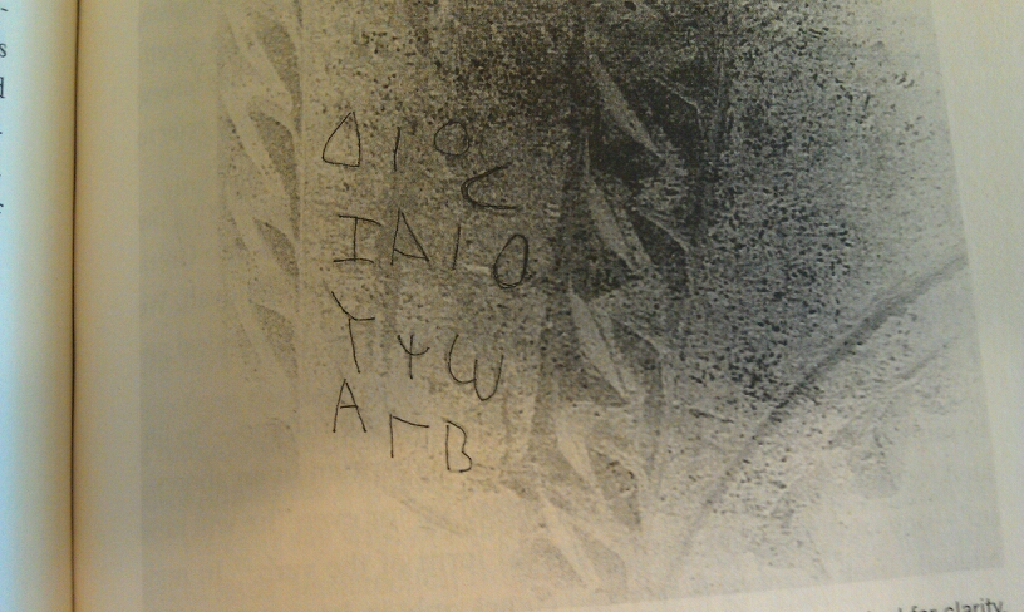
On February 28, 2012, James Tabor’s reading and translation of the four-line inscription was released. Namely, he and Simcha Jacobovici read it as follows: “DIOS IAIO UPSŌ AGB.” They translated their readings as “Divine Jehovah Lift up! Lift up!” Again, they believe Talpiyot Tomb 1981 to be a Christian tomb (in fact, they state that it is arguably the tomb of Joseph of Arimathea himself, although there is no ancient epigraphic evidence to suggest this) and they suggest that this four-line inscription is to be understood as reflective of an early Christian confession of a belief in the resurrection (and they have also argued that some of the ornamentation on a different ossuary from the same tomb is distinctively Christian, something that has been widely criticized as well). Also rather striking (and quite difficult to sustain), Tabor and Jacobovici have argued that the graphemes AGB (line 4) should be understood as the Greek transliteration of an H-stem verbal root gbh, although they had also mentioned (and dismissed) considering it to be a Semitic personal name transliterated into Greek graphemes, namely, “Agabus” (Tabor and Jacobovici, 90-94).

On February 28, 2012, around 1:00 p.m., a statement of mine was posted on the Official Blog of the American Schools of Oriental Research in which I discussed various aspects of Talpiyot Tombs 1980 and 1981 (Rollston 2012a). Among other things, I stated that: “Regarding the reading of line two, I wish to emphasize that I do not consider the reading “Yahweh” (i.e., the Greek form of it) to be convincing at all. Simply put, this reading is wrong. To be sure, the tetragrammaton is attested in ancient Greek (with various spellings) and Iaio can be considered a viable Greek spelling of the tetragrammaton. However, the problem is that the first grapheme of line two is not an iota (and, at the very least, this grapheme would be necessary for reading the tetragrammaton in this line). Of course, Tabor and Jacobovici believe that the first grapheme of this line is an iota, and they are obviously assuming that this grapheme consists of a distinct and deeply incised top horizontal, a bottom horizontal, and a long vertical connector. There is, however, a palaeographic problem with this reading. Here is the reason: for the Greek script(s) of the Late Second Temple period, the morphology of iota is quite consistently a vertical stroke (sometimes with modest curvature), but without distinct top or bottom horizontals. This is the case for Greek texts on soft media (e.g., papyri) and on hard media (e.g., stone). The panoramic Greek script charts of the great Princeton palaeographer Bruce Metzger are reflective of this (e.g., Metzger 1981, 23, figure 2). For further demonstration of this aspect of the morphology of this grapheme, readers might also wish to consult photos of the Greek textual material from this chronological horizon on soft media (e.g., the Greek papyri from the Bar Kokhba Cave of Letters; See Lewis 1989, passim ) and on hard media (e.g., Jerusalem Ossuary inscriptions; see CIIP 1. #64, 65, #98, #134, #189, 199, etc.). I would suggest that the convergence of the cumulative evidence demonstrates in a cogent manner that the first grapheme is simply not an iota. In reality, this grapheme is most readily understood as a tau (i.e., a top horizontal and a vertical) or (alternatively) a zeta. However, it is certainly not an iota. Of course, since there is no iota here, there is no tetragrammaton” (Rollston 2012a).

I did not provide all of my readings at that time, nor did I go into further detail about the palaeography, as my statement on February 28 was certainly not intended to be an editio princeps of that inscription. However, I did state in that initial article that I was “most comfortable with reading the last two graphemes of line one and the first two graphemes of line two as ‘osta,” that is, ‘bones,” a word that certainly does occur in a number of ossuary inscriptions and burial texts. Further, if one were to wish to read hupsō, I would then be inclined to understand this inscription to be stating that the bones of the deceased are not to be removed, that is, ‘lifted up’ from the ossuary” (Rollston 2012a).

On March 8th, 2012, Richard Bauckham responded with an article on the blog of the American Schools of Oriental Research. Bauckham stated that he believed “the inscription is actually very clear.” He also went on to indicate that he accepted all of Tabor’s readings (i.e., the Greek graphemes Tabor believes are present), but he translated the inscription as follows: “Belonging to Zeus IAIO. I, Hagab, exalt (him/you).” In addition, he states that “It is the only ossuary inscription to mention God in any way, let alone to use the divine name.” He also states that “as far as I know, our inscription is the only extant example of an identification of Yahweh with Zeus in a Palestinian Jewish context after the Maccabean period” (Bauckham 2012a). Bauckham also quoted my statement that the first grapheme of line two is definitely not an iota and then said of himself that although he “is not an epigrapher” (these are his words, not mine), he would “venture to say that he [Rollston] is being far too dogmatic.” He then went on to refer to a few examples and said they had “very distinct top and bottom horizontals.” However, it is significant that he goes on to use the term “serifs” (i.e., “apices”) for these strokes. Indeed, (in the examples he cites from CIIP) they are serifs, that is, lightly incised strokes, not full-blown deeply incised strokes. That is, they are not something that an epigrapher would normally consider to be good parallels for the full blown, deeply incised stroke that is at the top of the grapheme in question (i.e., the first grapheme of line two of the Talpiyot inscription). There was another problem as well, however, and Bauckham sensed it: “It does need to be explained why, in our inscription, only this letter is adorned with apices” (i.e., serifs). He’s certainly correct in deducing a serious problem with his view. Namely, the only grapheme in this four-line inscription from Talpiyot with serifs (i.e., what he understands to be serifs) is his and Tabor’s iota at the beginning of line two! After all, in the Greek epigraphic corpus from this period and horizon, when serifs are present, they are normally present on multiple graphemes (see the images I posted on the ASOR web site, Rollston 2012b). Here is Bauckham’s way of accounting for it: “The most likely reason seems to be that it is the first letter of the divine Name, which the writer wished to mark out as special.” He then goes on to state that “It is his equivalent of the various other ways of distinguishing the divine Name when it was written in Hebrew or Greek biblical manuscripts or elsewhere (such as the common practice among Qumran scribes of writing the Name in paleo-Hebrew chaacters” (Bauckham 2012a).

On March 15, 2012, in response to a number of requests, I wrote an article with my readings and some proposed translations (Rollston 2012b), as well as with palaeographic matters Bauckham had decided to discuss, especially the iota (and thus the tetrgrammaton) in line two of the Talpiyot inscription. Here is the essence of my epigraphic reply: “(1) I would note, however, that these inscriptions [the very ones to which Bauckham had referred] have serifs on multiple graphemes and just one, as the Talpiyot inscription allegedly does. (2) Furthermore, I would note that on most inscriptions with serifs, the serifs are not nearly as deeply incised as is (for example) the top horizontal of the Talpiyot grapheme Tabor and Bauckham consider to be an iota with a serifs. That is, the top horizontal of that grapheme does not have the appearance of a serif, but rather a full blown, deeply incised stroke. Bauckham senses the first problem and states that “it does need to be explained why, in our inscription, only this letter is adorned with apices [i.e., serifs].” He then states that “the most likely reason seems to be that it is the first letter of the divine Name, which the writer wished to mark out as special.” He goes on to suggest that this is similar to the way the divine name is treated in some Hebrew and Greek biblical manuscripts. He refers in particular to Qumran practice (Bauckham 2012a). However, I would note that the practice at Qumran is quite dissimilar. At Qumran, Emanuel Tov states that “divine names were written in a special way in many Hebrew Qumran texts” and then he provides the following synopsis: (A) All four graphemes of the tetragrammaton are written in Paleo-Hebrew characters in texts which are written in the square script; (B) Four dots in texts written in the square script; (C) A dicolon (:), followed by a space, placed before the Tetragrammaton (written in the square script); (D) the use of a different color of ink, in the case of 11Q22 (Tov 2004, 219-220, et passim; see also Tov 2001). In other words, there are no cases of the initial grapheme formed in a distinct way, but the remaining graphemes of the Tetragrammaton written in the standard (i.e., non-paleo-Hebrew) script. It is worth noting in this connection that Larry Hurtado has done a great deal of work on the Nomina Sacra in early Christian Greek manuscripts, but even in these manuscripts, there is nothing that parallels the sort of thing that Bauckham is proposing here (Hurtado 2006, 95-134; see also Metzger 1981, 36-37).

In addition to discussing these epigraphic factors, I provided all of my readings then (Rollston 2012b, i.e., March 15), using some of the photographs National Geographic provided me with in May 2011 and those published on the web (NB: I had served as the Epigraphic Consultant for National Geographic on this find for several months). Namely, I reiterated my reading of tau for the first grapheme of line two. Here are my words and I would draw the reader’s attention again to the images in my article, which are posted on ASOR’s Official Blog (Rollston 2012b): “I would ask the reader to look carefully at the image labeled Talpiyot 1, the second line, the first grapheme. At the bottom of the vertical of this grapheme is a pit in the stone (right next to the left oblique stroke of the alpha). I would ask the reader also to look at a different photograph, with a different light angle, namely, the image labeled Talpiyot 2. It is clear from this image that there is no horizontal stroke on the left side. Rather, there is a downward scratch (in fact, it may be that the person inscribing this ossuary made this mark when he was forming the upper part of the head of the upsilon, although it could have happened at almost any time). In any case, the point is that the “marks” Tabor and Bauckham considered the bottom horizontal of an iota are just pitting and scratches. Frankly, this sort of thing is very common in the field of epigraphy. The end result, of course, is that a recognition of the pitting and scratching yields a perfect tau. I should also make an additional notation regarding this line, namely, the grapheme Tabor and Bauckham consider to be the second iota. I draw the reader’s attention again to the image labeled Talpiyot 1, the second line and the third grapheme. It is a very clear epsilon, not an iota.”

Then I said: “Astute readers will have noticed, at this juncture, that the word osta “bones” can now be read (the last two graphemes of line one and the first two graphemes of line two). The normal spelling of this word in the plural is ostea, although the spelling osta is also well attested in the Greek corpus. In this case we have, I believe, either a dialectical variant in the pronunciation of this word (causing it to be spelled ostae, rather than ostea), an actual orthographic variant, or a simple orthographic error (all three of these things occurs in the corpus of ancient funerary inscriptions). In any case, reading “bones” in a funerary context is quite compelling. Moreover, the final grapheme of line two is an omicron and the first grapheme of the following line (line three) is an upsilon. This is, I believe, simply the negative, a lexeme that occurs rather frequently in tomb contexts when there are references to bones and ossuaries.”

I should mention in this connection that within that article of March 15, I discussed in some detail the sorts of statements that we find in Jewish burial contexts from the Late Second Temple and Early Post-Biblical chronological period. Of course, suffice it to say that words such as “bones” and “ossuary” are well attested.

I went on to note that in terms of readings, I would posit the following: DE OSTAE OU PSŌ AGB . Understanding the verbal to be psaō, I stated that “I would posit that it is reasonable to render this inscription: “Here are bones. I touch (them) not. Agabus. “ As such “Agabus” could be the name of the deceased, and thus this could be translated “Here are bones. I touch them not, O Agabus.” Conversely, it could also be that the first person singular is used here of the man who asserts that he does not touch bones. Thus, this could then be translated quite nicely as “Here are bones: I, Agabus, touch (them) not.” I suggested that the intransitive meaning is also viable. Thus, something such as “Here are (my) bones. I, Agabus, crumble not away.”

At that time, and now still, I also consider it possible to read the verb upsoō here (as I mentioned also in Rollston 2012a). In this case, it would read something along these lines: “Here are the bones. I lift not (the bones/ossuary), O Agabus,” or “Here are the bones. I, Agabus, lift (the bones/ossuary) not. I should note in this connection that I consider the proposal astutely suggested by Bauckham, namely, the presence of the personal name “Agabus” (in line four of the Talpiyot inscription) to be satisfying. In any case, the point is that the content of this inscription falls within the traditional sorts of statements that occur in Late Second Temple and Early Post-Biblical tomb contexts….it’s all about bones.

After reading my post, Robert Hull, a colleague of mine, suggested to me that rather than reading a form of ōde at the beginning of this inscription (as I did), he would prefer to read di, that is, a standard shortened form of the preposition dia. I suggested to him that the second grapheme of this inscription was abraded enough that I believed an iota to be a plausible reading for line one, grapheme two, that is, the short form of the preposition was something I considered viable. At my suggestion, he posted his proposal on ASOR’s blog as a comment to my article. Using his understanding of di, the rest of my readings, and one of my proposed possible renderings of the verb psaō, Hull proposed the following: “On account of [the] bones, I, Agabus, do not touch.” At that juncture, Bauckham, using my proposal of an intransitive meaning for psaō and all of my readings (but with Hull’s suggestion of di for dia),suggested (in the comment section of my March 15 ASOR blog post) the following: “Because of (these) bones, I, Hagab, am not crumbling away (disappearing).” He has also argued that he does not believe purity concerns should enter in to the discussion (i.e., he does not think them relevant). I have suggested that I think it is possible that purity or taboos might be part of the equation (i.e., as a possible rationale for the possible translation “I do not touch”).

Obviously, I am pleased with, and comfortable with, these suggested translations of my readings of the inscription. And, of course, I’m certainly comfortable with Hull’s understanding of a short form of di in line one. To be sure, though, I would not be surprised to find entha somewhere on this ossuary (which would then be joined with my initial reading of de at the beginning of line one, thus forming the very commonly attested beginning of funerary inscriptions, namely, enthade “here”). After all, on ossuaries, words, or portions thereof, sometimes begin on one part of an ossuary and then continue on a different part of the ossuary.

In short, in terms of readings for this very brief inscription (just fourteen graphemes!), I continue to contend for the following reading: DE OSTAE OU PSŌ AGB, while also considering viable: DI OSTAE OU PSŌ. In terms of the verb, it could be understood (as I suggested on March 15, Rollston 2012b) as psaō, with either the transitive or intransitive meanings I mentioned then (i.e., “I touch not,” or “I crumble not away”/”I disappear not”). Conversely, because we do see the shortened form of the negative attested epigraphically in Greek (i.e., o for ou; perhaps also compare the phenomenon of crasis in Greek), it is also viable to suggest (as I did in Rollston 2012a) that the verb preceded by the negative is indeed upsoō (i.e., “lift,” “raise up,” “exalt”), especially since a number of ossuary inscriptions refer to the movement or non-movement of ossuaries or bones (see Rollston 2012b for these references). Of course, in the latter case something such as this is tenable: “Because of the bones, I move not (the ossuary), O Agabus,” or “Because of the bones, I Agagus, move not (the ossuary),” with the ossuary being understood, as it is the thing being written upon. Of course, something such as “Here are the bones, I move not (the ossuary/bones), O Agabus,” or “Here are the bones, I Agabus move (the ossuary/bones) not” is also plausible. In sum, I consider this inscription to be about bones, and it is also clear that the tetragrammaton is simply not used in this inscription. I should mention here that Bauckham has recently posted a nice summary of the discussion of the inscription (Bauckham 2012b) and it is clear that he is now very disinclined to read the tetragrammaton in this inscription.

E. JAMES CHARLESWORTH’S MIS-READING OF “JONAH” ON THE AMPHORA OSSUARY

Most recently, James Charlesworth has stated that he believes the name “Jonah” is incised in the Aramaic script on the “Amphora Ossuary” (i.e., the ossuary Tabor and Jacobovici have dubbed the “Jonah” Ossuary”). I have looked closely at the photographs of this ossuary, especially the place where Charlesworth believes he sees letters encrypted. I would contend that there are no letters here, but rather these are just incisings that are part of the amphora. That is, this ossuary has a great deal of incising work on it and the incising that Charlesworth considers to be letters are just horizontal and vertical incising marks that were part of the production of the design of the amphora (see Posner 2012 for a discussion). The name “Jonah” is simply not here. Moreover, James Davila and Antonio Lombatti have stated the same thing, that is, Jonah is not there.

F. THE ORNAMENTATION: AN UNGUENTARIUM (AMPHORA), NOT A WHALE AND MAN

The presence of ornamental designs on an ossuary is fairly standard. Rosettes are among the most common ornamental motifs, but the repertoire is really quite broad. Rahmani has discussed them in great detail. He mentions that, in addition to rosettes, the attested ornamental motifs include things such as depictions of tomb facades, columned porches, lattice gates, nephesh towers, amphorae, menorahs, grapes and grapevines, palm trees, and even a putative fish (Rahmani 1994, 28-52). Of course, the fact that ossuaries would have such rich ornamental diversity should come as no surprise, as Late Second Temple period tombs themselves would sometimes be decorated rather nicely as well (see Berlin 2002, 138-148). The following pericope from Maccabees is also apropos in this connection: “Simon sent and took the bones of his brother Jonathan, and buried him in Modein, the city of his ancestors…and Simon built a monument over the tomb of his father and his brothers…he also erected seven pyramids, opposite one another, for his father and mother and four brothers. For the pyramids he devised an elaborate setting, erecting about them great columns, and on the columns he put suits of armor for a permanent memorial, and beside the suits of armor he carved ships…” (1 Macc 13:25-29).

Predictably, therefore, there are ornamental motifs on the ossuaries of Talpiyot Tomb 1981. One ornamental motif in particular has attracted the attention of Tabor and Jacobovici. Namely, Tabor and Jacobovici have contended that one ornamental motif is to be understood as Jonah and a fish. But they did not stop there. Rather, they have argued that this ornamental motif is not just any fish, they have actually argued that it is the dag gadol (the “big fish”) of the book of Jonah. But they went still further, as they speculated that the etchings at one end of the motif are a graphic depiction of Jonah himself, as he is being spewed from the mouth of the whale. In addition, they have also contended that this symbol should be understood here as the earliest reference to “Jonah as a symbol of the Christian resurrection,” citing the following text from the Greek New Testament: “For just as Jonah was in the belly of the sea monster for three days and three nights, so also shall the son of man be in the heart of the earth for three days and three nights” (Matt 12:40), as well as later Christian usage of the Jonah motif (Tabor and Jacobovici 83-90, et passim).

There has been more discussion about the ornamentation than about any other aspect of Talpiyot Tomb 1981. Joan E. Taylor sent an article to Eric Meyers and me on February 28, 2012 and stated that she believed the ornamentation was simply that of an unguentarium, that is, an amphora used to hold burial unguents such as nard. Taylor’s article was posted on ASOR’s blog within two days (Taylor 2012). At the same time, Antonio Lombatti suggested the same thing independently, as did also Tom Vereena. Moreover, scholars such as Mark Goodacre and Robert Cargill have also argued strongly for the very same thing (i.e., that it is an amphora), and it seems to me that there can be no real doubt about the fact that the ornamentation on the side of the ossuary in question is that of an amphora, something Rahmani listed as among the attested types of ornamentation on ossuaries. Indeed, it seems reasonable to refer to this ossuary as the “Amphora Ossuary,” rather than the “Jonah Ossuary” (the latter being the dubbing of Tabor and Jacobovici). I should note in this connection that Steven Fine (early in March 2012) made a sustained case for considering the ornamentation to be a nephesh tower (Fine 2012), something that seemed at that time quite convincing. Finally, it should be mentioned that already in 1981, an article in the Hebrew newspaper DAVAR reported on Talpiyot 1981 and suggested that the ornamentation on this ossuary was an amphora (Meyers and Rollston 2012).

G. DNA ANALYSES OF BONE FRAGMENTS; THINGS TABOR AND JACOBOVICI NEGLECTED TO MENTION

There is also a serious omission in Tabor and Jacobovici’s publications regarding the DNA. Prior to discussing the DNA evidence, certain things must be remembered: (1) Evidence from many Late Second Temple Jerusalem tombs demonstrates that multiple people were often buried in the same ossuary, and the names of all people whose bones are placed in ossuaries are often not all written on the ossuary. (2) Furthermore, the bones from the ossuaries of Talpiyot 1980 were not even “available to Amos Kloner [in 1996] for study since they had been transferred to the religious authorities for reburial, in accordance with an agreement that was made between the Israeli government and the religious authorities who objected to the storage of human bones within the Antiquities Authority’s storerooms” (Gibson 2006, 120); thus, they were certainly not available to Tabor and Jacobovici. (3) Of course, Tabor and Jacobovici were able to find some small bone fragments, but the problem is that it is not possible to know if the fragments Tabor and Jacobovici sent for analysis are those of someone whose name is on the ossuary! There are, therefore, some “missing links” in any attempt to do DNA analyses and there is no way to overcome these problems.

In any case, Tabor and Jacobovici had DNA tests done on the few bone fragments still present in the “Yeshua’ Ossuary” and the “Mariame kai Mara Ossuary” (i.e., after these ossuaries of Talpiyot Tomb 1980 had been cleaned and the bones reburied long ago). They have stated that it was not possible to recover Nuclear DNA, but it was possible to recover Mitochondrial DNA (Tabor and Jacobovici, 196-202). Here are the statements Tabor and Jacobovici have made: In the “Mariamene” ossuary “we found only tine bone chips.” Or again, “the bone chips we found contained no marrow.” And yet again, “There was no possibility of nuclear or gDNA with these samples due to their degradation.” Or again, “It is unfortunate that we were not able to conduct full DNA tests on all of the bones found in all the ossuaries from the Jesus tomb. Ideally that would have allowed one to construct a kind of provisional ‘family tree,’ at least in terms of the familial genetic relationships between those individuals buried therein. Since the bones themselves were never examined scientifically and no one is even sure what happened to them, that opportunity is forever lost” (Tabor and Jacobovici, 199-202).” Because the mitochondrial DNA from these two ossuaries did not match (i.e., that is, they did not have the same mother, or were not those of a son and mother), Tabor and Jacobovici believed that it was safe to conclude that the people whose bone fragments were removed from these two ossuaries might have been married (in fact, they believe that it is safe to assume that these bones are those of Jesus of Nazareth and Mary Magdalene, whom they propose was married to Jesus of Nazareth).

It should be emphasized that it is not methodologically prudent to assume that there was only one person buried in the “Yeshua’ Ossuary” and only one person buried in the “Mariame kai Mara Ossuary.” After all, multiple people were often buried in the same ossuary and when this occurs it is commonplace for all the names *not* to be listed. Moreover, with the “Mariame kai Mara Ossuary,” one can make a good case for the fact that the inscription itself refers to two people, not one. Furthermore, there is also something else that is of critical importance: from mitochondrial DNA, one cannot determine gender! Thus, the bones from the “Yeshua’ Ossuary” could readily be those of a woman and those of the “Mariame kai Mara Ossuary” could readily be those of a man! Obviously, this is a critically important aspect of the DNA evidence, but rather than mentioning this, Tabor and Jacobovici simply assume (and thereby lead their readers to assume) that the bone fragments from the “Yeshua’ Ossuary” are definitely those of a man, and they assumed that those from the “Mariame kai Mara Ossuary” are definitively those of a woman. Obviously, this serves the purposes of Tabor and Jacobovici very well, but it is hardly a conclusion that follows directly from the evidence. Ultimately, this “omission” of theirs demonstrates decisively that candor about the DNA evidence was not provided by Tabor and Jacobovici, and this is a most unfortunate omission.

H. PRESUMED CONNECTIONS BETWEEN TALPIYOT TOMBS 1980 and 1981

Tabor and Jacobovici have argued that these two tombs are definitely connected in some fashion (indeed, their terms “Talpiyot A” and “Talpiyot B” seem to suggest just this, even though there are additional tombs in this part of East Talpiyot). They begin by mentioning that these two tombs are around two hundred feet apart and then they state that “the new discovery [i.e., Talpiyot Tomb 1981] increases the likelihood that the ‘Jesus Family Tomb’ [i.e., Talpiyot Tomb 1980] is, indeed, the real tomb of Jesus of Nazareth.” Tabor and Jacobovici further conclude that “both tombs appear to have been part of the property of a wealthy individual possibly Joseph of Arimathea, the man who, according to the gospels, buried Jesus.” But I would note that there is no necessary connection between these two tombs. That is, ca. 200 feet is not a small distance. Moreover, I would emphasize that there is no epigraphic evidence to connect these two tombs, and there is no archaeological evidence to suggest a close connection either. In short, it is speculative to assume that these two tombs are to be connected.

I. JESUS OF NAZARETH AND MARY MAGDALENE: NO EARLY EVIDENCE SUGGESTING SEX OR MARRIAGE

Tabor and Jacobovici contend that Jesus of Nazareth was married to Mary Magdale and that they had a son named Yehudah. They think the evidence from these tombs proves all of this and they also suggest that some hints of this can be found in the New Testament and Early Christian literature. Bart Ehrman, a premiere scholar of the Greek New Testament and Early Christianity, has stated that the question people most ask him is this: “Were Mary Magdalene and Jesus of Nazareth married?” Here is Ehrman’s answer: “It is not true…that the Dead Sea Scrolls contained Gospels that discussed Mary and Jesus.” “Nor is it true that the marriage of Mary and Jesus is repeatedly discussed in the Gospels that didn’t make it into the New Testament. In fact, it is never discussed at all—never even mentioned, not even once.” He goes on and notes that “It is not true that the Gospel of Philip calls Mary Jesus’ spouse.” Then he queries: “What what does the historical evidence tell us about Mary and Jesus?….it tells us nothing at all—certainly nothing to indicate that Jesus and Mary had a sexual relationship of any kind” (Ehrman 2006, 248). Ehrman’s historical analysis is dead on. I completely concur with him.

CONCLUSIONS

In sum, the technology used on Talpiyot Tomb 1981 by Tabor and Jacobovici is interesting and it would have been nice to be able to focus on it. Moreover, it would have been nice to have had a sober discussion by Tabor and Jacobovici about the finds from Talpiyot Tombs 1980 and 1980; nevertheless, this did not occur. Ultimately, therefore, this volume is replete with a superabundance of problems. I have just discussed a few of them. Some of the additional problems have been dealth with by scholars such as James McGrath and Mark Goodacre, who have focused especially on Tabor and Jacobovici’s problematic use of New Testament texts (see the ASOR Blog for these posts as well). I fear that this volume will be used in the field of academics primarily as “a case study of flawed methodologies and flawed practices”. The reason for this is simply that there are so many tenuous assumptions, leaps of logic, and omissions of data. This is all really quite tragic. Fortunately, there has been a cadre of scholars working to correct the assertions and arguments of Tabor and Jacobovici and this has been most useful. Moreover, the American Schools of Oriental Research deserves a great deal of credit for providing a forum for much of the discussion.

SELECT BIBLIOGRAPHY

Bauckham, R.
2012a “The Four-Line Ossuary Inscription from Talpiyot Tomb B—An Interpretation.” ASOR Blog March 2012. http://asorblog.org/?p=1848.

Bauckham, R.
2012b “The Four-Line Greek Inscription from Talpiyot Tomb B: A Summary of Options for Reading and Interpreting It.” April 2012. http://larryhurtado.files.wordpress.com/2012/04/bauckham-talpiyot-tomb-inscription.pdf

Bauer, W., Arndt, W.F., Gingrich, FW., Danker, F.W.
2000 A Greek-English Lexicon of the New Testament and other Early Christian Literature, 3rd
ed. Chicago: The University of Chicago Press.

Berlin, A. M.
2002 Power and its Afterlife: Tombs in Hellenistic Palestine. NEA 65: 138-148.

CIIP 1
2010 Corpus Inscriptionum Iudaeae/Palaestinae: volume I, Jerusalem, Part 1, 1-704. H. Cotton, L. Di Segni, W. Eck, B. Isaac, A. Kushnir-Stein, H. Misgav, J. Price, I. Roll, and A. Yardeni, eds. Berlin: DeGruyter.

Collins, J. J.
1998 The Apocalyptic Imagination: An Introduction to Jewish Apocalyptic Literature, 2nd ed.
Biblical Resource Series. Grand Rapids: Eerdmans.

Di Lella, A. A.
1966 “Conservative and Progressive Theology: Sirach and Wisdom.” CBQ 28: 139-154.

Ehrman, B. D.
1999 Jesus: Apocalyptic Prophet of a New Millennium. New York: Oxford Press.

2006 Peter, Paul, and Mary Magdalene: The Followers of Jesus in History and Legend. New York: Oxford.

Feuerverger, A.
2007 “Open Letter to Statistical Colleagues on the Tomb Computation.” Online:
http://fisher.utstat.toronto.edu/andrey/OfficeHrs.txt.

Fine, Steven. “Comments from Prof. Steven Fine on the Jesus Discovery.” http://asorblog.org/?p=1705.

Friedrich, G.
1972 Theological Dictionary of the New Testament: Volume 8. Grand Rapids: Eerdmans.

Gibson. S.
2006 “Is the Talpiot Tomb Really the Family Tomb of Jesus?” NEA 69: 118-124.

Hoftijzer, J. and Jongeling, K.
1995 Dictionary of the North-West Semitic Inscriptions. Leiden: Brill.

Hurtado, L. W. T
2006 The Earliest Christian Artifacts: Manuscripts and Christian Origins. Grand Rapids: Eerdmans.

Ilan, Tal.
2002 Lexicon of Jewish Names in Late Antiquity. Tübingen: Mohr Siebeck.

Jacobovici, S. and Pellegrino, C.
2007 The Jesus Family Tomb: The Discovery, the Investigation, and the Evidence that Could Change History. New York: Harper Collins.

Jastrow, M.
1950 A Dictionary of the Targumim, the Talmud Babli and Yerushalami, and the Midrashic
Literature. New York: Pardes Publishing House.

Koehler, L. and Baumgartner, W.
1994-2000 The Hebrew and Aramaic Lexicon of the Old Testament. Leiden: Brill.

Kraeling., Carl H.
1946 “Christian Burial Urns.” Biblical Archaeologist 9: 16-20.

Lampe, G. W. H.
1961 A Patristic Greek Lexicon. Oxford: Clarendon Press.

Lewis, N.
1989 The Documents from the Bar Kokhba Period in the Cave of Letters: Greek Papyri. Judean
Desert Studies. Jerusalem: Israel Exploration Studies.

Liddell, H. G. and Scott, R.
1993 A Greek-English Lexicon, rev. and augmented ed. Oxford: Clarendon Press.

Meyers, E. M.
2006 “The Jesus Tomb Controversy: An Overview.” NEA 69: 116-118.

Meyers, E.M. and Rollston, C.A.
2012. “Jonah Ossuary Discussed in Print in 1981.” http://asorblog.org/?p=2237

Metzger, B. M.
1981 Manuscripts of the Greek Bible: An Introduction to Greek Palaeography. New York:
Oxford University Press.

Nickelsburg, G. W.E., Jr.
1972 Resurrection, Immortality, and Eternal Life in Intertestamental Judaism. Harvard
Theological Studies 26. Cambridge: Harvard University Press.

Oikonomides, Al. N.
1974 Abbreviations in Greek Inscriptions: Papyri Manuscripts and Early Printed Books.
Chicago: Ares Publishers.

Pfann, S. J.
2006 “Mary Magdalene Has Left the Room: A Suggested New Reading of Ossuary CJO 701.”
NEA 69: 130-131.

Posner, Michael,
2012. “Ancient Ossuary Hints at Earliest Reference to Jesus.” April 12, 2012. http://www.theglobeandmail.com/news/national/ancient-%C2%AD%E2%80%90ossuary-%C2%AD%E2%80%90hints-%C2%AD%E2%80%90at-%C2%AD%E2%80%90earliest-%C2%AD%E2%80%90reference-%C2%AD%E2%80%90to-%C2%AD%E2%80%90jesus/article2399269/

Rahmani, L. Y.
1994. A Catalogue of Jewish Ossuaries in the Collections of the State of Israel. Jerusalem: Israel Antiquities Authority.

Rollston, C.A.
2006 “Inscribed Ossuaries: Personal Names, Statistics, and Laboratory Tests.” NEA 69: 125-
129.

2012a “The Four-Line Greek Inscription from a Talpiyot Tomb: Epigraphic Notes and Historical
Discussions.” ASOR Blog March 15, 2012. http://asorblog.org/?p=1989.

2012b “The four-Line Ossuary Inscription from Talpiyot Tomb B (1981): Summary and Restatement.” March 17, 2012. http://www.rollstonepigraphy.com/?p=448

Scham, S.
2006 “Trial by Statistics.” NEA 69: 124-125.

Sukenik, E.L.
1931 “Nochmals: Die Ossuarien in Palästina.” Monatsschrift für Geschichte und
Wissenschaft des Judentums 75: 462-463.

Tabor, J. D.
2006 “Testing a Hypothesis.” NEA 69: 132-136.

2012 “A Preliminary Report of a Robotic Camera Exploration of a Sealed 1st Century Tomb in East Talpiyot, Jerusalem.” Bible and Interpretation web site, February 28, 2012.

Tabor, J. D. and Jacobovici, S.
2012 The Jesus Discovery: The New Archaeological Find that Reveals the Birth of Christianity. New York: Simon and Schuster.

Taylor, J.E.
2012 “The Talpiyot Ungentarium. March 2, 2012. http://asorblog.org/?p=1778

Tov, E.
2004 Scribal Practices and Approaches Reflected in the Texts Found in the Judean Desert (STDJ 54; Leiden/Boston: E. J. Brill.

Yadin, Y.
1971 Bar-Kokhba: The Rediscovery of the Legendary Hero of the Second Jewish Revolt against Rome. New York: R
The Four-Line Ossuary Inscription from Talpiyot Tomb B (1981): Summary and Restatement

17 March 2012

There has been some substantial discussion about the four-line inscription, its readings and its renderings. The purpose of this post is to delineate the history of published proposals, summarizing salient points. Most of my posts on this find have been posted on the Official Blog of the American Schools of Oriental Research. For this reason, and because of subsequent discussion, I am now posting this summation here.

On February 28, 2012, James Tabor’s reading and translation of the four-line inscription was released. Namely, he and Simcha Jacobovici read it as follows: “DIOS IAIO UPSŌ AGB.” They translated their readings as “Divine Jehovah Lift up! Lift up!” They believe “Talpiyot Tomb B” to be a Christian tomb (in fact, they state that it is arguably the tomb of Joseph of Arimathea himself, although there is no ancient epigraphic evidence to suggest this) and they suggest that this four-line inscription is to be understood as reflective of an early Christian confession of a belief in the resurrection (and they have also argued that some of the ornamentation on a different ossuary from the same tomb is distinctively Christian, something that has been widely criticized as well). Also rather striking (and quite difficult to sustain), Tabor and Jacobovici have argued that the graphemes AGB (line 4) should be understood as the Greek transliteration of an H-stem verbal root gbh, although they had also mentioned (and dismissed) a suggestion of Richard Bauckham that it be considered a Semitic personal name transliterated into Greek graphemes, namely, “Agabus” (Tabor and Jacobovici 2012, 90-94; Tabor 2012, 18, no 42).

On February 28, 2012, around 1:00 p.m., a statement of mine was posted on the blog of the American Schools of Oriental Research in which I discussed various aspects of Talpiyot Tombs A and B (Rollston 2012a). Among other things, I stated that: “Regarding the reading of line two, I wish to emphasize that I do not consider the reading “Yahweh” (i.e., the Greek form of it) to be convincing at all. Simply put, this reading is wrong. To be sure, the tetragrammaton is attested in ancient Greek (with various spellings) and Iaio can be considered a viable Greek spelling of the tetragrammaton. However, the problem is that the first grapheme of line two is not an iota (and, at the very least, this grapheme would be necessary for reading the tetragrammaton in this line). Of course, Tabor and Jacobovici believe that the first grapheme of this line is an iota, and they are obviously assuming that this grapheme consists of a distinct and deeply incised top horizontal, a bottom horizontal, and a long vertical connector. There is, however, a palaeographic problem with this reading. Here is the reason: for the Greek script(s) of the Late Second Temple period, the morphology of iota is quite consistently a vertical stroke (sometimes with modest curvature), but without distinct top or bottom horizontals. This is the case for Greek texts on soft media (e.g., papyri) and on hard media (e.g., stone). The panoramic Greek script charts of the great Princeton palaeographer Bruce Metzger are reflective of this (e.g., Metzger 1981, 23, figure 2). For further demonstration of this aspect of the morphology of this grapheme, readers might also wish to consult photos of the Greek textual material from this chronological horizon on soft media (e.g., the Greek papyri from the Bar Kokhba Cave of Letters; See Lewis 1989, passim ) and on hard media (e.g., Jerusalem Ossuary inscriptions; see CIIP 1. #64, 65, #98, #134, #189, 199, etc.). I would suggest that the convergence of the cumulative evidence demonstrates in a cogent manner that the first grapheme is simply not an iota. In reality, this grapheme is most readily understood as a tau (i.e., a top horizontal and a vertical) or (alternatively) a zeta. However, it is certainly not an iota. Of course, since there is no iota here, there is no tetragrammaton” (Rollston 2012a).

I did not provide all of my readings at that time, nor did I go into further detail about the palaeography, as my statement on February 28 was certainly not intended to be an editio princeps of that inscription. However, I did state in that initial article that I was “most comfortable with reading the last two graphemes of line one and the first two graphemes of line two as ‘osta,” that is, ‘bones,” a word that certainly does occur in a number of ossuary inscriptions and burial texts. Further, if one were to wish to read hupsō, I would then be inclined to understand this inscription to be stating that the bones of the deceased are not to be removed, that is, ‘lifted up’ from the ossuary” (Rollston 2012a).

On March 8th, 2012, Richard Bauckham (who had been working with James Tabor and Simcha Jacobovici) responded with an article on the blog of the American Schools of Oriental Research. Bauckham stated that he believed “the inscription is actually very clear.” He also went on to indicate that he accepted all of Tabor’s readings (i.e., the Greek graphemes Tabor believes are present), but he translated the inscription as follows: “Belonging to Zeus IAIO. I, Hagab, exalt (him/you).” In addition, he states that “It is the only ossuary inscription to mention God in any way, let alone to use the divine name.” He also states that “as far as I know, our inscription is the only extant example of an identification of Yahweh with Zeus in a Palestinian Jewish context after the Maccabean period” (Bauckham 2012). Bauckham also quoted my statement that the first grapheme of line two is definitely not an iota and then said of himself that although he “is not an epigrapher” (these are his words, not mine), he would “venture to say that he [Rollston] is being far too dogmatic.” He then went on to refer to a few examples of iota and said they had “very distinct top and bottom horizontals.” However, it is significant that he goes on to use the term “serifs” (i.e., “apices”) for these strokes. Indeed, (in the examples he cites from CIIP) they are serifs, that is, lightly incised strokes, not full-blown deeply incised strokes. That is, they are not something that an epigrapher would normally consider to be good parallels for the full blown, deeply incised stroke that is at the top of the grapheme in question (i.e., the first grapheme of line two of the Talpiyot inscription). There was another problem as well, however, and Bauckham sensed it: “It does need to be explained why, in our inscription, only this letter is adorned with apices” (i.e., serifs). He’s certainly correct in deducing a serious problem with his view. Namely, the only grapheme in this four-line inscription from Talpiyot with serifs (i.e., what he understands to be serifs) is his and Tabor’s iota at the beginning of line two! After all, in the Greek epigraphic corpus from this period and horizon, when serifs are present, they are normally present on multiple graphemes (see the images I posted on the ASOR web site, Rollston 2012b). Here is Bauckham’s way of accounting for it: “The most likely reason seems to be that it is the first letter of the divine Name, which the writer wished to mark out as special.” He then goes on to state that “It is his equivalent of the various other ways of distinguishing the divine Name when it was written in Hebrew or Greek biblical manuscripts or elsewhere (such as the common practice among Qumran scribes of writing the Name in paleo-Hebrew chaacters” (Bauckham 2012).

On March 15, 2012, in response to a number of requests, I wrote an article with my readings and some proposed translations (Rollston 2012b), as well as a detailed discussion of palaeographic matters Bauckham had posted about, especially the iota (and thus the tetrgrammaton) in line two of the Talpiyot inscription. Here is the essence of my epigraphic reply: “(1) I would note, however, that these inscriptions [the very ones to which Bauckham had referred] have serifs on multiple graphemes and just one, as the Talpiyot inscription allegedly does. (2) Furthermore, I would note that on most inscriptions with serifs, the serifs are not nearly as deeply incised as is (for example) the top horizontal of the Talpiyot grapheme Tabor and Bauckham consider to be an iota with a serifs. That is, the top horizontal of that grapheme does not have the appearance of a serif, but rather a full blown, deeply incised stroke. Bauckham senses the first problem and states that “it does need to be explained why, in our inscription, only this letter is adorned with apices [i.e., serifs].” He then states that “the most likely reason seems to be that it is the first letter of the divine Name, which the writer wished to mark out as special.” He goes on to suggest that this is similar to the way the divine name is treated in some Hebrew and Greek biblical manuscripts. He refers in particular to Qumran practice (Bauckham 2012). However, I would note that the practice at Qumran is quite dissimilar. At Qumran, Emanuel Tov states that “divine names were written in a special way in many Hebrew Qumran texts” and then he provides the following synopsis: (A) All four graphemes of the tetragrammaton are written in Paleo-Hebrew characters in texts which are written in the square script; (B) Four dots in texts written in the square script; (C) A dicolon (:), followed by a space, placed before the Tetragrammaton (written in the square script); (D) the use of a different color of ink, in the case of 11Q22 (Tov 2004, 219-220, et passim; see also Tov 2001). In other words, there are no cases of the initial grapheme formed in a distinct way, but the remaining graphemes of the Tetragrammaton written in the standard (i.e., non-paleo-Hebrew) script. It is worth noting in this connection that Larry Hurtado has done a great deal of work on the Nomina Sacra in early Christian Greek manuscripts, but even in these manuscripts, there is nothing that parallels the sort of thing that Bauckham is proposing here (Hurtado 2006, 95-134; see also Metzger 1981, 36-37).

In addition to discussing these epigraphic factors, I provided all of my readings then (Rollston 2012b, i.e., March 15), using some of the photographs National Geographic provided me with in May 2011 and those published on the web (NB: I had served as the Epigraphic Consultant for National Geographic on this find for several months). Namely, I reiterated my reading of tau for the first grapheme of line two. Here are my words and I would draw the reader’s attention again to the images in my article, which are posted on ASOR’s Official Blog (Rollston 2012b): “I would ask the reader to look carefully at the image labeled Talpiyot 1, the second line, the first grapheme. At the bottom of the vertical of this grapheme is a pit in the stone (right next to the left oblique stroke of the alpha). I would ask the reader also to look at a different photograph, with a different light angle, namely, the image labeled Talpiyot 2. It is clear from this image that there is no horizontal stroke on the left side. Rather, there is a downward scratch (in fact, it may be that the person inscribing this ossuary made this mark when he was forming the upper part of the head of the upsilon, although it could have happened at almost any time). In any case, the point is that the “marks” Tabor and Bauckham considered the bottom horizontal of an iota are just pitting and scratches. Frankly, this sort of thing is very common in the field of epigraphy. The end result, of course, is that a recognition of the pitting and scratching yields a perfect tau. I should also make an additional notation regarding this line, namely, the grapheme Tabor and Bauckham consider to be the second iota. I draw the reader’s attention again to the image labeled Talpiyot 1, the second line and the third grapheme. It is a very clear epsilon, not an iota.”

Then I said: “Astute readers will have noticed, at this juncture, that the word osta “bones” can now be read (the last two graphemes of line one and the first two graphemes of line two). The normal spelling of this word in the plural is ostea, although the spelling osta is also well attested in the Greek corpus. In this case we have, I believe, either a dialectical variant in the pronunciation of this word (causing it to be spelled ostae, rather than ostea), an actual orthographic variant, or a simple orthographic error (all three of these things occurs in the corpus of ancient funerary inscriptions). In any case, reading “bones” in a funerary context is quite compelling. Moreover, the final grapheme of line two is an omicron and the first grapheme of the following line (line three) is an upsilon. This is, I believe, simply the negative, a lexeme that occurs rather frequently in tomb contexts when there are references to bones and ossuaries.”

I should mention in this connection that within that article of March 15, I discussed in some detail the sorts of statements that we find in Jewish burial contexts from the Late Second Temple and Early Post-Biblical chronological period. Of course, suffice it to say that words such as “bones” and “ossuary” are well attested.

I went on to note that in terms of readings, I would posit the following: DE OSTAE OU PSŌ AGB . Understanding the verbal to be psaō, I stated that “I would posit that it is reasonable to render this inscription: “Here are bones. I touch (them) not. Agabus. “ As such “Agabus” could be the name of the deceased, and thus this could be translated “Here are bones. I touch them not, O Agabus.” Conversely, it could also be that the first person singular is used here of the man who asserts that he does not touch bones. Thus, this could then be translated quite nicely as “Here are bones: I, Agabus, touch (them) not.” That is, purity issues or general taboos about contact with bones could be in play, as Talmudicist Steven Fine has suggested to me privately. I should mention also in this connection (as I did in one of my comments on the ASOR blog for this article, namely, one made March 15, 5:41 p.m.) that it is important to remember that (although some ossuaries were inscribed in the tomb, before or after disarticulated remains were placed in the ossuary) ossuaries could also be inscribed (A) at a workshop at the time of manufacture, (B) or after the time of manufacture but prior to the placement of the ossuary in the tomb, (c) or after the placement in the tomb but prior to the placement of bones in the ossuary. Thus, one could readily envision the inscription being placed on this ossuary (at some point) prior to the deposition of the bones, and this could be the semantic framework for the inscription, that is, prior to the deposition of the bones, the stone mason wrote: “I do not touch the bones.” Obviously, we cannot answer this with certitude, but it is a plausible option as a Sitz im Leben for this inscription. In any case, I also suggested (in Rollston 2012b) that the intransitive meaning is also viable. Thus, something such as “Here are (my) bones. I, Agabus, crumble not away.”

At that time, and now still, I also consider it possible to read the verb upsoō here (as I mentioned also in Rollston 2012a). In this case, it would read something along these lines: “Here are the bones. I lift not (the bones/ossuary), O Agabus,” or “Here are the bones. I, Agabus, lift (the bones/ossuary) not. I should note in this connection that I consider the proposal suggested by Bauckham (but rejected by Tabor), namely, the presence of the personal name “Agabus” (in line four of the Talpiyot inscription) to be satisfying (Tabor 2012, 16, no 42). In any case, the point is that the content of this inscription falls within the traditional sorts of statements that occur in Late Second Temple and Early Post-Biblical tomb contexts….it’s all about bones.

After reading my post, Robert Hull, a colleague of mine, suggested to me that rather than reading a form of ōde at the beginning of this inscription (as I did), he would prefer to read di, that is, a standard shortened form of the preposition dia. I suggested to him that the second grapheme of this inscription was abraded enough that I believed an iota to be a plausible reading for line one, grapheme two, that is, the short form of the preposition was something I considered viable. At my suggestion, he posted his proposal on ASOR’s blog as a comment to my article. Using his understanding of di, the rest of my readings, and one of my proposed possible renderings of the verb psaō, Hull proposed the following: “On account of [the] bones, I, Agabus, do not touch.” At that juncture, Bauckham, using my proposal of an intransitive meaning for psaō and all of my readings (but with Hull’s suggestion of di for dia), suggested (in the comment section of my March 15 ASOR blog post) the following: “Because of (these) bones, I, Hagab, am not crumbling away (disappearing).” He stated further in that comment that “this actuall makes good sense in terms of a Jewish understanding of resurrection, which depended on the bones as the continuity between the body in the present life and the body in resurrection. The rest of the body decays, but the bones survive to be resurrected.” Nnote that Bauckham has emphasized multiple times in his comments on Rollston 2012b [that is, on the ASOR blog], that he believes issues of purity and impurity simply do not play a part in this inscription, while I continue to believe that issues of purity-impurity, or general taboos, could be operative, as Talmudic scholar Steven Fine has suggested.

Obviously, I am pleased with, and comfortable with, these suggested translations of my readings and understandings of the inscription. And, of course, I’m certainly comfortable with Hull’s understanding of a short form of di in line one. To be sure, though, I would not be surprised to find entha somewhere on this ossuary (which would then be joined with my initial reading of de at the beginning of line one, thus forming the very commonly attested beginning of funerary inscriptions, namely, enthade “here”). After all, on ossuaries, words, or portions thereof, sometimes begin on one part of an ossuary and then continue on a different part of the ossuary.

In short, in terms of readings for this very brief inscription (just fourteen graphemes!), I continue to contend for the following reading: DE OSTAE OU PSŌ AGB, while also considering viable: DI OSTAE OU PSŌ. In terms of the verb, it could be understood (as I suggested on March 15, Rollston 2012b) as psaō, with either the transitive or intransitive meanings I mentioned then (i.e., “I touch not,” or “I crumble not away”/”I disappear not”). Conversely, because we do see the shortened form of the negative attested epigraphically in Greek (i.e., o for ou; perhaps also compare the phenomenon of crasis in Greek), it is also viable to suggest (as I did in Rollston 2012a, that is, February 28) that the verb preceded by the negative is indeed upsoō (i.e., “lift,” “raise up,” “exalt”), especially since a number of ossuary inscriptions refer to the movement or non-movement of ossuaries or bones (see Rollston 2012b for these references). Of course, in the latter case something such as this is tenable: “Because of the bones, I lift not (the ossuary), O Agabus,” or “Because of the bones, I Agagus, lift not (the ossuary),” with the ossuary being understood, as it is the thing being written upon. Of course, something such as “Here are the bones, I lift not (the ossuary/bones), O Agabus,” or “Here are the bones, I Agabus lift (the ossuary/bones) not” are also plausible. In sum, I consider this inscription to be about bones, and it is also clear that the tetragrammaton is simply not used in this inscription.

Christopher Rollston

___________

Bibliography

Bauckham, R.
2012 “The Four-Line Ossuary Inscription from Talpiyot Tomb B—An Interpretation.” ASOR
Blog March 2012. http://asorblog.org/?p=1848.

CIIP 1
2010 Corpus Inscriptionum Iudaeae/Palaestinae: volume I, Jerusalem, Part 1, 1-704. H. Cotton, L. Di Segni, W. Eck, B.
Isaac, A. Kushnir-Stein, H. Misgav, J. Price, I. Roll, and A. Yardeni, eds. Berlin: DeGruyter.

Lewis, N.
1989 The Documents from the Bar Kokhba Period in the Cave of Letters: Greek Papyri. Judean
Desert Studies. Jerusalem: Israel Exploration Studies.

Metzger, B. M.
1981 Manuscripts of the Greek Bible: An Introduction to Greek Palaeography. New York:
Oxford.

Rollston, C. A.
2012a “Reflections of an Epigrapher on Talpiyot Tombs A and B: A Detailed Response to the
Claims of Professor James Tabor and Filmmaker Simcha Jacobovici.” ASOR Blog
February 2012. http://asorblog.org/?p=1642.

Rollston, C.A.
2012b “The Four-Line Greek Inscription from a Talpiyot Tomb: Epigraphic Notes and Historical
Discussions.” ASOR Blog March 2012. http://asorblog.org/?p=1989.

Tabor, J. D.
2012 “A Preliminary Report of a Robotic Camera Exploration of a Sealed 1st Century Tomb in East Talpiyot,
Jerusalem.” Bible and Interpretation web site. Posted February 28, 2012.

Tabor, J.D. and Jacobovici, S.
2012 The Jesus Discovery: The new Archaeological find that Reveals the Birth of Christianity.
Simon and Schuster, 2012.

BELIEF IN THE RESURRECTION IN ANCIENT CONTEXT

17 March 2012

BELIEF IN THE RESURRECTION IN ANCIENT CONTEXT:
LATE SECOND TEMPLE JUDAISM, EARLY POST-BIBLICAL JUDAISM, AND EARLY CHRISTIANITY

There is often a great deal of misunderstanding about this subject generally. That is, people who do not work in ancient history or ancient religion often assume that a belief in a resurrection was some sort of distinctively Christian belief. That, however, is a serious misconception. The fact of the matter is that within various segments of Late Second Temple Judaism, as well as within Early Post-Biblical Judaism, the notion of a resurrection was warmly embraced by many. The locus classicus in the Hebrew Bible is arguably the following text from the mid-2nd century BCE: “Many of those sleeping in the dust of the earth shall awaken, some to everlasting life and some to everlasting peril” (Dan 12:2; notice here that the correlative of “damnation” or “hell” is also present in some fashion, of course). Within the Old Testament Apocrypha, the notion of a resurrection is embraced at times as well, with the narrative about the martyrdom of “the mother and her seven sons” being a fine exemplar of this. Thus, according to the narrative, one of the sons said during the torture that preceded his death: “the King of the universe will raise us up to an everlasting renewal of life, because we have died for his laws” (2 Macc 7:9). Similarly, the mother herself says within the narrative, as an exhortation to her martyred sons: “the Creator of the world…will in his mercy give life and breath back to you again” (2 Macc 7:23). 2 Maccabees arguably hails from the first half of the 1st century BCE. Regarding the dead, the Wisdom of Solomon also affirms that the dead “seemed to have died,” but “they are at peace,” and “their hope is full of immortality,” and they will ultimately “shine forth” and “will govern nations and ruler over peoples” (Wisdom 3:2-8 passim, with the Greek future tense being used here). The Wisdom of Solomon arguably hails from the second half of the 1st century BCE. Significantly, all of these texts antedate the rise of Christianity and they all affirm a belief in a resurrection. In short, many Jewish people believed in a resurrection long before Christianity came along. To be sure, a belief in a resurrection was not universally accepted by all Jewish people in the Second Temple period. Some Jewish people did not believe in a resurrection. For example, the traditionalist Ben Sira rejected the notion of eternal bliss for the righteous and eternal punishment for the wicked. Thus, he wrote: “Who in the netherworld can glorify the Most High, in place of the living who offer their praise? No more can the dead give praise than those who have never lived; they glorify the Lord who are alive and well” (Sir 17:27-28). In sum, although not all Jewish people of the Late Second Temple period accepted the notion of a resurrection, there are texts from this period that demonstrate that a fair number did.

Furthermore, the Jewish historian Josephus (lived ca. 37-100 CE) also discusses the subject of the perishability and imperishability of the soul, with regard to some of the major strands of Judaism during the first century of the Common Era. Regarding the Pharisees, therefore, he states that they believe “every soul is imperishable, but the soul of the good alone passes into another body, while the souls of the wicked suffer eternal punishment.” Conversely, regarding the Sadducees he states that “as for the persistence of the soul after death, penalties in the underworld, and rewards; they will have none of them.” Regarding the Essenes, Josephus states that they believe “the body is corruptible and its constituent matter impermanent, but that the soul is immortal and imperishable…sharing the belief of the sons of Greece, they maintain that for virtuous souls there is reserved an abode beyond the ocean, a place which is not oppressed by rain or snow or heat, but is refreshed by the ever gentle breath of the west wind coming in from ocean, while they relegate base souls to a murky and tempestuous dungeon, big with never-ending punishments” (Josephus, Jewish War, II, 11-14; for more discussion, see Nickelsburg 1972, 164-169). Of course, pericopes within the Greek New Testament regarding the Pharisees and Sadducees dovetail nicely with Josephus. The locus classicus for the New Testament is arguably contained within the book of Acts: “The Sadducees say that there is no resurrection, or angel, or spirit; but the Pharisees acknowledge all three” (Acts 23:8; cf. also Matt 22:23). Of course, within Early Christianity, the notion of a resurrection (and the presumed correlative, “hell”, is also attested in some form in Daniel 12:2) predominates, as the soil from which Christianity especially hails is that of apocalyptic Late Second Temple Judaism (Ehrman 1999). Pericopes within the Greek New Testament such as “The Rich Man and Lazarus” (Luke 16:19-31) and “The New Heaven and New Earth” (Rev 21) reflect this, of course. Moreover, the belief in a resurrection persists in subsequent chronological horizons of Early Christianity as well (e.g., see Ferguson 1999, 16,23, 26, 65-78).

In short, based on evidence from literary texts associated with Late Second Temple Judaism and Early Christianity, scholars of the Hebrew Bible, Second Temple Judaism, the Greek New Testament, and Early Christianity have for a very long time dealt with these ancient assumptions about the afterlife; therefore, the consensus of the field has long been that some Jewish people within the Late Second Temple period embraced a belief in a resurrection and some did not (e.g., DiLella 1966; Collins 1998; Ehrman 1999). Of course, Christianity too (originally a sect of Judaism, with strong apocalyptic tendencies) did embrace a notion of a resurrection, and this is very clear from the documents of the Greek New Testament. But the fact remains that many Jewish people of the late Second Temple Period believed in a resurrection, not just Jewish Christians, and the fact remains that a belief in the resurrection is attested within Judaism prior to the rise of Christianity. This is just a historical fact.

Significantly, for Late Second Temple Judaism and Post-Biblical Judaism, epigraphic evidence also demonstrates that some Jewish people believed in a resurrection and some did not. For example, an inscription in a corridor of the Jewish catacombs of Beth She’arim reads as follows: “Best wishes in the Resurrection!” (Greek: “anastasis”; Schwabe and Lifschitz 1974, 180 [#194]). Moreover, one ossuary from Jerusalem has the following: “No one has abolished/cancelled his entering, not even El‘azar and Shapira” (CIIP 1. #93). Similarly, a Jerusalem ossuary has the following Greek inscription: “Cheer up and feast, you brothers who are living, and drink together! No one is immortal” (CIIP 1. #395). Similarly, an inscription in a mausoleum adjacent to catacomb eleven at Beth She’arim has the following inscription: “I, the son of Leontios, lie dead, Justus, the son of Sappho, who, having plucked the fruit of all wisdom, left the light, my poor parents in endless mourning, and my brothers too, alas, in my Beth She‘arim, And having gone to Hades, I Justus, lie here with many of my own kindred, since mighty Fate so willed. Be of good courage, Justus, no one is immortal” (Schwabe and Lifschitz 1974, 97 [#127]). Similarly, an inscription from Beth She’arim reads: “Be of good courage, Simon; no one is immortal” (Schwabe and Lifschitz 1974, 35-36 [#59]). Or again from Beth She’arim: “Be of good courage, lady Calliope from Byblos; no one is immortal” (Schwabe and Lifschitz 1974, 124-125 [#136]). From a Greek inscription from Beth She’arim: “May your portion be good, my lord father and lady mother, and may your souls be bound in immortal life” (Greek: athanatou biou; Schwabe and Lifschitz 1974, 114-116 [#130]). Among the longest of this sort of inscription from Beth She’arim is the following: “this tomb contains the dwindling remains of noble Karteria, preserving forever her illustrious memory. Zenobia brought her here for burial, fulfilling thus her mother’s behest. For you, most blessed of women, your offspring, whom you bore from your gentle womb, your pious daughter, for she always does actions praiseworthy in the eyes of mortals, erected this monument so that even after the end of life’s term, may you both enjoy again indestructible riches” (Schwabe and Lifschitz 1974, 157-167 [#183]). Similarly, an inscription from Beth She’arim says: “May your lot be good, Hannah” (Schwabe and Lifschitz 1974, 2-3 [#2]). Or again, one of the Beth She’arim inscriptions contains the following statement: “Julianus Gemellus, may your share be good” (Schwabe and Lifschitz 1974, 8 [#13]). And again, “Sarah, mother of Yosi, have courage” (Schwabe and Lifschitz 1974, 16 [#22]). Likewise, an ossuary from Beth She’arim has the word “peace” in Greek and Hebrew and in its entirety it reads as follows: “Shalom, little Yosi, Shalom” (Schwabe and Lifschitz 1974, 19 [#28]). In sum, some epigraphic texts from ancient Judaism presuppose a belief in a resurrection and some do not.

Thus, in the final analysis, the cumulative evidence is decisive: There is nothing distinctively “Christian” about a belief in a resurrection. Rather, some segments of Late Second Temple and Early Post-Biblical Judaism believed in a resurrection and some segments did not. Christianity, as an heir to apocalyptic branches of Judaism, was quite consistent in always affirming a belief in a resurrection, but the fact remains that belief in a resurrection is well attested prior to the rise of Christianity, and this belief also persists in certain segments of Judaism after the rise of Christianity.

Christopher Rollston

CIIP 1
2010 Corpus Inscriptionum Iudaeae/Palaestinae: volume I, Jerusalem, Part 1, 1-704. H. Cotton, L. Di Segni, W. Eck, B. Isaac, A. Kushnir-Stein, H. Misgav, J. Price, I. Roll, and A. Yardeni, eds. Berlin: DeGruyter.

Collins, J. J.
1998 The Apocalyptic Imagination: An Introduction to Jewish Apocalyptic Literature, 2nd ed.
Biblical Resource Series. Grand Rapids: Eerdmans.

Di Lella, A. A.
1966 “Conservative and Progressive Theology: Sirach and Wisdom.” CBQ 28: 139-154.

Ehrman, Bart
1999 Jesus: Apocalpytic Prophet of the new Millennium. New York: Oxford.

Ferguson, E.
1999 Early Christians Speak: Faith and Life in the First Three Centuries. 3rd edition. Abilene:
Abilene Christian University Press.

Nickelsburg, G. W.E., Jr.
1972 Resurrection, Immortality, and Eternal Life in Intertestamental Judaism. Harvard
Theological Studies 26. Cambridge: Harvard University Press.

Schwabe, M. and Lifschitz, B.
1974. Beth She‘arim: Volume II, the Greek Inscriptions. Jerusalem: Israel Exploration Society and the Institute of Archaeology of Hebrew University.

REFLECTING ON SOME OF THE MOTIVATIONS OF FORGERS

15 March 2012

Various motivations can be deduced (with some certitude) for the production of forgeries. (1) Venality is certainly a component present in the production and sale of forgeries. Non-provenanced inscriptions routinely sell for four, five, and even six figures. Some recent non-provenanced inscriptions have been valued at seven figures. (2) Some forgeries are arguably the result of “sour grapes” (e.g., a student purged from a Northwest Semitic epigraphy program) or professional rivalry, with the forger hoping to “dupe” the “offender.” (3) Naturally, sometimes a forgery can be a prank. For example, the forger of the Hebron Documents was probably a prankster (or a dolt, or both). (4) Moreover, there is a certain amount of prestige associated with being the person who “collects,” “vets,” or “finds” a significant “ancient epigraph” from the market. Indeed, the public (and even scholars within the field) can sometimes lionize such people, often suspending critical mental faculties (and thus assessments of antiquity) because of “sensational” non-provenanced epigraphs. (5) Religion and politics are also strong motives for the production of a forgery. For example, there was arguably a strong religious motivation for the production of the Shapira Fragments (and the initial aura surrounding them). The fact that the Jehoash Inscription was “reported to have been found in the region of the Temple Mount” has political and religious overtones. Ultimately, forgers are arguably motivated by a combination of such factors, and, of course, with each success, hubris is fostered.

Finally, I should like to note that those who suggest that “knowledgeable people” would not engage in the production or vetting of a forgery are being rather naïve. The fact of the matter is that even gifted scholars have been implicated for the production of forgeries. For example, Metzger has stated that former Princeton classicist Coleman-Norton (Metzger’s Doktorvater) concocted an apocryphal story about finding a manuscript of a Greek translation of the Latin Opus Imperfectum in Matthaeum (in the North African town of Fedhala), and then published a detailed article about his sensational “find.” That is, to assume that bright, well-trained people are always characterized by professional ethics is belied by “epigraphic history.”

This post is a selection from my article in Maarav 10 (2003): 135-193…and from pages 191-193 in particular.

The Israeli Forgery Trial: The Verdict is Given

14 March 2012

Epigraphic forgeries have been produced for more than two millennia, and they continue to be produced. Among the most famous from the Middle Ages is the The Donation of Constantine, a document that was hailed as ancient and important…until Lorenza Valla demonstrated (1407-1457 CE) the damning philological and historical evidence against its authenticity. Similarly, an inscription referred to as the “Brazilian Phoenician Inscription” was forged during the late 1800s and purported to be an account of Sidonians landing in Brazil. M. Lidzbarski declared it to be a forgery (in 1898), but Cyrus Gordon revived this inscriptional debate and argued (in 1968) that it was indeed an ancient Phoenician inscription. Galvanized by Gordon’s declarations, Frank Cross demonstrated (in 1968) very nicely that this inscription was forged in the modern period.

Similarly, in 1971 G. Mendenhall argued that some inscriptions from the antiquities market, inscriptions dubbed “The Hebron Philistine Documents” were ancient, and he subsequently stated that progress was being made in decipherment of these ancient documents. Frank Cross, however, stated in an annual meeting of the Society of Biblical Literature that year that these documents were modern forgeries. But Mendenhall chided Cross (without naming him in print) and stated that those who said these documents were modern forgeries simply “do not want to be confused with new facts” and “have already made up their minds about what the ancient world was supposed to produce.” Mendenhall went on to state that “the only scholars who are convinced of their authenticity are those who have worked seriously with the original documents, including the extremely productive computer analysis.” He also said (in 1970 and 1971) that “it is very difficult to believe that scholars capable of putting such an enormous range of information into these documents would also be capable of such irresponsible misuse of learning.” Because these sorts of statements persisted, Joseph Naveh wrote an article entitled “Some Recently forged Inscriptions” in the Bulletin of the American Schools of Oriental Research (1982) and demonstrated that these Hebron inscriptions were modern forgeries, and of a particuarly poor sort, as they were basically the Siloam Tunnel Inscritpion written backwards!

Mendenhall’s statement suggesting basically that “no one who has such knowledge would ever do something such as this” is oft cited by many people in different contexts (but mostly it is cited by those who wish to state that this or that modern forgery must be ancient because no person capable of producing a forgery would do so). Of course, (sadly) Mendenhall was too sanguine with regard to his assumptions about human nature and human motives. This is demonstrated most convincingly by the fact that Princeton University Professor P. R. Coleman-Norton published an article in Catholic Biblical Quarterly (in 1950) about finding a manuscript which was a Greek translation of the Latin Opus Imperfectum in Matthaeum, a manuscript he said he came across in the North African town of Fedhala. In his autobiography entitled Reminiscences of an Octogenarian Princeton Theological Seminary professor Bruce Metzger demonstrated that this “ancient manuscript” Coleman-Norton had said he found was non-existent, and that the entire thing was a Witz, as even the title of the editio princeps demonstrated (it was entitled “An Amusing Agraphon”). In short, very capable scholars are also capable of producing forgeries, and of this there can be no doubt. Of course, even the best forgeres make mistakes…and trained palaeographers can discern these, and this also has long been the case (although some scholars are more capable than others at this, as history also demonstrates).

Naturally, with regard to some of the inscriptions that were part of this trial, it is important to remember that Joseph Naveh argued in print (in an article in Israel Exploration Journal) that the “Two Moussaieff Ostraca” were probable forgeries (in 1998). After collating most of the provenanced Old Hebrew inscriptions in the late 1990s and then looking carefully at the Moussaieff Ostraca, I began to argue (publicly, beginning in March 1999) that these two Moussaieff Ostraca were definitive modern forgeries. Of course, during the 2001 and 2002 the “Jehosash Inscription” surfaced. Joseph Naveh considered it a modern forgery (he told me this in an e-mail, in response to my e-mail to him in which I mentioned the numerous palaeographic problems I saw in this inscription which were demonstrative of its status as a modern forgery…and Naveh told me he felt the same way). Frank Cross also told me in an e-mail (in response to my e-mail to him, listing the palaeographic problems with the Jehoash Inscription) that he too believed the Jehoash Inscription to be a modern forgery and he too soon wrote an article for Israel Exploration Journal arguing that the Jehoash Inscription was indeed a modern forgery. At the same time, I was in the process of completing a long article on epigraphic forgeries for Maarav (published in 2003…and now available on Academia.edu), which included a long palaeographic discussion of the problems with the Moussaieff Ostraca and so I augmented that article with my observations about the palaeographic problems with the Jehoash Inscription. Frank Cross subsequently told me in an e-mail (which he sent in response to a penultimate draft of my long Maarav article on forgeries, an e-mail I still have) that he had become convinced that these Moussaieff Ostraca were indeed modern forgeries as well (he had previously been quoted in print as saying they were genuine). In fact, Cross went even further and stated in an open letter that he also considered the Ivory Pomegranate to be a modern forgery as well. Yuval Goren of Tel Aviv University became involved during this time as the primary scholar who used hard science analyses on these inscriptions (and many others), and his conclusions were that these inscriptions were indeed modern forgeries. There were dissenting voices, but not many.

Of course, the discussion in Israel soon focused on those that were believed to have forged some of these inscriptions. Based on various lines of evidence, there was a decision to attempt to prosecute those believed to be responsible for at least some of the most recent modern forgeries. For a nice summary of the objects that were part of the trial, discussion of the problems with the antiquities market, and with forgeries in general, readers might wish to consult the articles in Near Eastern Archaeology 68 (2005). As part of that trial, I was brought to Israel to testify a few years ago and did so…beginning one morning at around nine in the morning and finishing shortly before eleven p.m. It was a long, but productive day. I found the prosecutors, Dan Bahat and Adi Damti, to be gifted, devoted prosecutors. Moreover, Judge Aharon Farkash is a very fine judge, learned, wise. The problem is that he did not believe there was enough evidence “to prove guilt beyond a reasonable doubt.” Significantly, however, speaking about the Ya’akov Ossuary (“James Ossuary”) in particular, Judge Farkash also stated (quite reasonably) that this “is not to say that the inscription on the ossuary is true and authentic and was written two thousand years ago.” Also, Prosecutor Dan Bahat has stated that the case had been “complicated by the refusal of a key witness, who was suspected of helping to forge many of the items, to come from Egypt to testify.” Bahat also stated that “What we have tried to do here is to set an international precedent.” Further elaborating, he said, “this is the first time someone has brought the issue of antiquiteis forgery before a court.”

At the end of the day, regardless of the guilt or innocent of those individuals charged and tried for forging inscriptions in this case, the fact remains that forgeries have been produced for more than two millennia and I do not forsee this changing. Indeed, it never will…after all, the motives for forgeries are numerous, from venality, to sour grapes, to a Witz, and from antiquity to the modern period even extend to realms of motivation in the realms of the political and religious.. I have an article coming out in a Brown University Symposium volume on the history of forgeries…and I have an academic monograph on this subject that will be sent off to a publisher this coming summer….so the saga continues…

James Tabor’s Iota: A Palaeographic Problem for his Inscriptional Reading

8 March 2012

Tabor's Drawing of Four-Line Inscription

James Tabor has argued that the four-line Greek inscription from the tomb which he and Simcha Jacobovici have dubbed “Talpiyot Tomb B” should be read as follows: (1) DIOS; (2) IAIO; (3) UPSW; (4) AGB. He renders it “Divine Jehovah Lift, Lift Up.” Richard Bauckham (on the ASOR blog) has followed Tabor’s readings (i.e., the Greek letters Tabor believes to be there), although Bauckham prefers to translate it “Belonging to Zeus IAIO. I, Hagab, exalt (him/you).” There is much that I like about Bauckham’s discussion in general, and I am very pleased by his basic conclusions.

Palaeographers, however, would note a rather serious problem for Tabor and Bauckham’s reading of line two…namely, the dramatic difference in the morphology of the iota, as a viewing of Tabor’s own drawings (p. 91, _The Jesus Discovery_) demonstrates. Thus, Tabor and Bauckham read an iota at the beginning of line two, but one with very long horizontal crossbars (a palaeographic problem I shall soon discuss in a long palaeographic and philological post here, replete with all of my readings and a full translation). However, the next grapheme they read as an iota is a straight vertical (with no horizontals). Variation in the same hand on ossuary inscriptions is certainly attested, but this great of morphological variation for this grapheme is not attested in the epigraphic corpus from this region during this chronological horizon. This is, of course, a serious problem for their reading of this ossuary inscription. Suffice it to say that I remain convinced that this inscription does not mention Yahweh, but it does mention “bones” (i.e., Greek “osta“).

Christopher Rollston

Joseph of Arimathea and Talpiyot Tomb B? An Absence of Reasonable Evidence for a Connection

5 March 2012

James Tabor and Simcha Jacobovici have posited that Talpiyot Tomb B is a tomb belonging to Joseph of Arimathea (i.e., the “Joseph of Arimathea” mentioned in the canonical gospels), and that this tomb also contains the actual ossuary of Joseph of Arimathea himself. Here are some citations of Tabor and Jacobovici’s views: Talpiyot Tombs A and B “are most likely located on the rural estate of Joseph of Arimathea, a wealthy member of the Sanhedrin who according to all four New Testament gospels took official charge of Jesus’ burial” (Tabor and Jacobovici, 2). But he is framed as wealthy and so they believe they have to account for the modest nature of this ossuary, thus, they suggest that there may have been “something about his faith or piety as part of the Jesus movement” that led him to “prefer such a modest bone box” (Tabor and Jacobovici, 89). Then they conclude that “it is not hard or even overly speculative for us to posit that the Talpiyot Tombs are a tiny but amazing glimpse into the life of Joseph of Arimathea” (Tabor and Jacobovici, 128).

The ossuary in Talpiyot Tomb B which they consider to be that of Joseph of Arimathea is one they also refer to as a “humble ossuary” (Tabor and Jacobovici, 89). Along the same lines, they query: “might Joseph of Arimathea have chosen a…modest ossuary for himself and his most immediate family—but one that boldly proclaimed their faith even in the midst of opposition and conflict?” (Tabor and Jacobovici, 90). It should be noted that the reason they refer to this ossuary as “boldly proclaiming their faith” is because the ossuary they believe to be that of “Joseph of Arimathea” is the one with the ornamentation they understand to be “Jonah and the Big Fish.” Of course, most scholars consider this ornamentation to be a nephesh tower or an unguentarium, not “Jonah and the Big Fish.”

In any case, the main point that I would emphasize at this time is this: The known inscriptions in Talpiyot Tomb B are (1) a four line inscription which has no reference to someone named “Joseph,” and certainly no reference to someone named “Joseph of Arimathea,” and (2) an inscription consisting of a single word, namely, “Mara” which they consider to be a reference to a woman, not a man (Tabor and Jacobovici, 127). They suggest that there is “circumstantial evidence,” namely, they suggest that “Arimathea” means “high” and Talpiyot is a “high” place. Of course, I would suggest that just being a “high” place is pretty circumstantial evidence indeed! Moreover, I would note that “Arimathea” is called a polis (Luke 23:51), that is, a “city,” rather than just a “high” place. Thus, I would suggest that most scholars will not consider the evidence to which Tabor and Jacobovici refer to be considered sufficient for their claim.

I would propose that for a historian to make a credible argument that this is the land, tomb, and ossuary of Joseph of Arimathea there must be solid evidence, such as the name “Joseph of Arimathea” inscribed on the ossuary. But, since these words are not there, it is really not convincing to posit that this is the tomb of Joseph of Arimathea. Tabor and Jacobovici may believe that it is not “hard or overly speculative” to say that this is the land, tomb, and ossuary of Joseph of Arimathea, but I think most epigraphers, prosopographers, and historians would find it to be quite speculative.

Reference:

James D. Tabor and Simcha Jacobovici, The Jesus Discovery: The New Archaeological Find that Reveals the Birth of Christianity. New York: Simon and Schuster, 2012

Tabor and Jacobovici’s New Volume: Epigraphic Reflections on it

28 February 2012

On February 28th, James Tabor and Simcha Jacobocici’s new volume was released, arguging that Jesus of Nazareth was married to Mary Magdalene, that they had a son named Yehudah and all of them were ultimately interred in East Talpiyot (Jerusalem), a tomb which they previously dubbed “The Jesus Family Tomb,” and which they now also term “Talpiyot Tomb A.” Along with others, I interacted with these claims several years ago and my article in Near Eastern Archaeology 69 (2006) is posted below, in its entirety, as part of previous post on my blog site.

This new volume by Tabor and Jacobovici, however, also contains much discussion about a different tomb in East Talpiyot, namely, one which they have dubbed “Talpiyot Tomb B.” It is ca. two hundred feet from the tomb they refer to as “Talpiyot Tomb B.” Two inscriptions from Talpiyot Tomb B have garnered substantial attention. The first one is simply “Mara,” a term which is most easily understood as a masculine, but which can be used as a shortened form of “Martha,” and thus as a feminine (Tabor and Jacobovici prefer to consider it a feminine, but I do not believe there is any way to know this with certainty). The second inscription consists of four lines and it is quite difficult. Tabor and Jacobovici consider it to contain the divine name “Yahweh” written in Greek letters and followed by a word for “lift up,” or “resurrect.” Moreover, they consider an ornamental motif on one of the other ossuaries in Talpiyot Tomb B to be a graphic depiction of Jonah being spewed from the mouth of a “dag gadol,” that is, the “big fish mentioned in the book of Jonah. Together, they argue that the totality of the evidence suggests this is a first century Jewish-Christian tomb (and that it may have belonged to a character of the gospels known as Joseph of Arimathea).

The technology Tabor and Jacobovici used to photographic Talpiyot Tomb B is really quite impressive. But, I am very disinclined to accept their interpretations of Talpiyot Tomb A or Tomb B. Indeed, regarding the four-line inscription, I would note that the name Yahweh (written in Greek letters) is simply not present…not on line two of this inscription (where they read it) and not on any of the three remaining lines of this inscription either. Actually, I consider it most likely that this inscription refers to the necessary reverence and care of bones (e.g., I read the last two letters of line one as omicron and sigma and the first two letters of line two as tau and alpha…that is, the word “osta,” an attested plural form of the word for “bones.”). I would also note that the word(s) “of Arimathea” do(es) not occur anywhere in this tomb, nor does the personal name “Joseph.” Moreover, regarding the word they understand to refer to “resurrection” or “lifting up” (hence their statements that this tomb’s inscriptions are Christian and refer to a resurrection), I would simply note that even if the word hupso is present in this inscription, it need not refer to a resurrection (in fact, that meaning of this word is a secondary or tertiary meaning at best). Also, many Second Temple Jews believed in a resurrection, not just Jewish Christians…so even a reference to a “resurrection” would not necessarily make this some sort of a Jewish-Christian tomb. All of these sorts of problems make the basic thrust of their arguments (for Talpiyot Tomb A and Talpiyot Tomb B) quite difficult for me to accept…the evidence is simply not there. Dramatic claims require dramatic evidence and it is simply lacking in this case. Also, I should mention that regarding the ornamentation on one ossuary which they consider to be a graphic depiction of “Jonah and the Whale,” I feel that it is most readily understood as a traditional Jewish nephesh tower, much as Eric Meyers has suggested.

Finally, I should note that I have known about these finds from Talpiyot Tomb B for about nine months, as I served as the epigraphic consultant for National Geographic with regard to this find (ultimately, the show was purchased from National Geographic by the Discovery Channel…an interesting story in and of itself…). I had been required to sign a Non-Disclosure Agreement, but after Jacobovici and Tabor broke the story early this morning, I was free to write….thus, two blog articles of mine were placed on the official blog of the American Schools of Oriental Research early today, the first a brief statement with the salient points and the second a longer, detailed statement totaling about twenty pages in my manuscript. I thought about publishing my views on my own blog here, but it seemed preferable, and most useful, for my sentiments about these finds to be there. At this time, therefore, I simply refer the reader to the ASOR blog, where my detailed comments will be found, along with the comments of additional scholars. I plan to publish my full reading of this inscription in a journal, but in the meantime, I believe my detailed blog post will suffice. Here is the URL for my longer blog post: www.asor.org/?p=1642.

With all best wishes,

Christopher Rollston

Professor Christopher Rollston Collating Inscriptions in the Middle East

28 February 2012


« Previous PageNext Page »