The Hazor Tablet Fragments: Further Details and Musings

26 July 2010

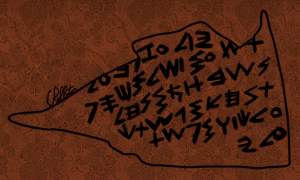
Fragment of Hazor Tablet

Data about the Cuneiform Fragments from Hazor continue to be released.  Here are some of the most recent details: (1) There are two fragments.  One of the fragments is very small indeed. (2) Akkadian words that can be translated into English as “master,” “slave,” and arguably “tooth” have been read.  (3) Wayne Horowitz has been cited as stating that the style is reminiscent of the phrasing of the Code of Hammurabi (i.e., the famed Old Babylonian Law “Code”).  All of these are useful data.  Further details will certainly soon be forthcoming.

Reflections.  At this juncture, (1) It seems that there is the assumption that these two fragments are from a single tablet.  I think that this seems reasonable.  Of course, the best means of determining this sort of thing is a certain and clear join of fragments.  Often, though (in the absence of a certain and clear join), it is reasonable to posit that two fragments are of the same tablet based on the proximity of the fragments (i.e., found in situ next to each other).  Nevertheless, proximity of fragments cannot be considered quite as definitive as a clear and certain join.  (2) Legal texts are very common in the ancient Near East and are attested at numerous sites through the course of time.  (3) Hammurabi is a very famous “Code.”  Nevertheless, “Codes” such as Eshunna and Lipit Ishtar are also known.  Also, note the Middle Assyrian Laws…a fairly large corpus of legal texts (and sometimes the term “code” is used of these as well).  That is, Hammurabi is arguably the most famous “code” (i.e., famous now, in the modern period) but it is not the only extant law “code.” Note: in terms of chronological horizon, Expedition Director Amnon Ben-Tor has recently characterized these fragments as “Mari Age” (Itamar Singer, personal correspondence).   Along these lines, it should be noted that, as Raymond Westbrook (my teacher of all things legal) often stated…the term “law code” cannot be readily used of these ancient Near Eastern texts, as they are not “codes” in anything approximating modern legal codes (as modern legal codes are considerably more extensive).  Thus, I use the term “code” of these ancient Near Eastern texts with Westbrook’s caveat in mind.  (4) Words that can be translated “man,” or “citizen,” or “master,” or “slave” are quite common in legal texts (e.g., , “awilum” meaning “man,” “citizen,” etc. or “wardu” meaning “slave,” or “servant”).  (5) “Shumma Awilum” is a phrase that can be rendered “If a man,” and it is the standard way that each consecutive Law of Hammuarib begins (the same is basically true of the various law “codes”).  As noted above, Horowitz refers to the style of these new fragments as similar to Hammurabi.  This causes me to suggest that something similar to this phrase has been deciphered in the new Hazor fragments.  (6) Within one story Horowitz is cited as saying: that this latest discovery “opens an interesting avenue for possible further investiation of a connection between Biblical Law and the Code of Hammurabi.”  I concur and suspect (as I mentioned in a previous post) that the contours of this discussion were articulated nicely in two recent Maarav articles. 

Christopher Rollston

Legal Tablet from Hazor

19 July 2010
 

Here is an auspicious press release from the Hazor Expedition:

Hazor Law Code Fragments

The Selz Foundation Hazor Excavations in Memory of Yigael Yadin have recovered two fragments of a cuneiform tablet preserving portions of a law code at Hazor.

The text parallels portions of the famous Law Code of Hammurabi, and, to a certain extent even the Biblical “tooth for a tooth”. The team is presently working its way down towards a monumental structure dating to the Bronze Age, where more tablets are expected to be found.

The tablet is currently being studied at the Hebrew University. More details to follow as soon as possible.

The excavations are sponsored by the Hebrew university and the Israel Exploration Society, and take place in the Hazor National Park.

End of press release.

_________

________

Rollston’s Bibliographic Suggestions and Brief Reflections on this Subject…

Because the Code of Hammurabi is mentioned (in the press release), readers might wish to refer to the discussion published in MAARAV between David Wright and Bruce Wells.  Namely, Wright, “The Laws of Hammurabi as a Source for the Covenant Collection…” (MAARAV 10 [2003]: 11-87), and then a response from Bruce Wells entitled “The Covenant Code and Near Eastern Legal Traditions: A Response to David P. Wright” (MAARAV 13 [2006]: 85-118), then Wright’s reply entitled “The Laws of Hammurabi and the Covenant Code: A Response to Bruce Wells” (MAARAV 13 [2006]: 211-260).  Wright subsequently published a book that revolves around this subject matter (and the substance of Wright’s MAARAV articles are contained in the book). 

In any case, because of the nature of this new Hazor find, and the wording of the press release, I suspect that the same issues that Wells and Wright discuss (in a very collegial, but direct, fashion) will soon surface again, this time as part of this new Hazor tablet.

Most readers will already know this, but suffice it to state that the amount of extant legal material in Mesopotamian cuneiform is vast…coming from the Center (i.e., Mesopotamia proper) and also from the Periphery (e.g., Syria). 

Christopher Rollston 

Reflections on the Fragmentary Cuneiform Tablet from the Ophel:

14 July 2010


Rollston’s Reflections on the Fragmentary Cuneiform Tablet from the Ophel:

A Critique of the Proposed Historical Context

Introduction

 In IEJ 60 (2010): 4-21 a cuneiform tablet (written in Akkadian) from recent excavations in Jerusalem has been published (it will be referred to henceforth as “Jerusalem 1”).  It was not found in situ, but rather during the process of “wet sieving,” something that was done “for the contents of loci holding special significance.”  The editio princeps was produced in a most timely fashion under the title “A Cuneiform Tablet from the Ophel in Jerusalem.”  The authors (Eilat Mazar, Wayne Horowitz, Yuval Goren and Takayoshi Oshima) are to be congratulated for a most expeditious, detailed, and useful publication of this find.

 Summary

 Within the article, the tablet is affirmed to be from the Late Bronze Age (and this seems reasonable, based on the data provided).  The soil of the tablet has been analyzed and it was determined that the soil was from the region of Jerusalem.  That is, the soil is local and so the tablet was written in Jerusalem (and, thus, not written in some distant region).  The obverse and the reverse are inscribed.  Very few signs are preserved.  According to the editio princeps: the legible words are (as translated into English):

 Obverse:

 1.  [        ]; 2. “You were…[ ]; 3. “a foundation/after for. […]; 4. “to do. […]; 5.  [           ].

 Reverse: 

1. [        ]; 2. [           ]; 3. “they [  ]; 4. [     ];

  ____

 Of course, within the Amarna Corpus, there are several letters from a certain King Abdi-Heba of Jerusalem (Moran, The Amarna Letters, Johns Hopkins University Press, 1992; see letter numbers 285-290).  This can be, and has been for more than a century, considered a reliable basis for arguing that there were trained scribes in Jerusalem during the Amarna Period (i.e., the reigns of the Egyptian Kings Amenophis III and Amenophis IV).  The “Jerusalem 1 tablet” (just published) is of special interest, as it was discovered in Jerusalem and it was also written in Jerusalem; therefore, it constitutes corroborating evidence for a scribal apparatus in Jerusalem during (at least a portion of) the Late Bronze Age, arguably under royal aegis.

 The cuneiform script of Jerusalem 1 strikes me as neat and sophisticated (in contrast with some of the Peripheral Akkadian that is known from sites such as Emar, Nuzi, etc.) and within the editio princeps, it is stated that “the hand of Jerusalem 1…can be categorized as higher rather than lower” (i.e., the quality of the script is high).  It is also stated that some signs on the Jerusalem fragment “match those of the Abdi-Heba letters (MU, NA, ZI, I, BI, SHU, and A), but some do not (NU, AM, TUM, ISH, AL, and mostly likely SHA, although this sign is not completely preserved on Jerusalem 1.”  It is also stated that “the differences between Jerusalem 1 and EA 285-290 do not allow us to identify the scribe of Jerusalem 1 with the scribe (or, more likely, scribes) of the Abdi-Heba letters.  In fact, it is our impression that the scribe of Jerusalem 1 shows greater expertise than the scribes of Abdi-Heba in El-Amarna 285-290.”  The authors state that in one case (“i-pe-sha,” meaning “to do”) there may be a “clear indication of Amarna-type phraseology,” but they concede that three attested occurrences (which they note) “do not a rule make.”

 Strikingly, the authors conclude that “given the fact that the tablet is written on clay from the Jerusalem region and that its find site is close to what must have been the acropolis of Late Bronze Age Jerusalem, there is good reason to believe that the letter fragment does, in fact, come from a letter of a king of Jerusalem, mostly likely an archive copy of a letter from Jerusalem to Pharaoh” (emphasis mine).  It is also contemplated that, for Jerusalem 1, the “Jerusalem King in question could be Abdi-Heba,” but the authors also state “but again perhaps not, since Jerusalem 1 does not include any specific feature that would tie it directly to El Amarna 285-290.”  They then conclude that “in short, the ductus of our letter fragment would be appropriate for a finely written letter from a king of Jerusalem to the Egyptian court.”  It is with the probability of these historical conclusions and Sitz im Leben that I wish respectfully to differ. 

 Critical Reflections

 So, here are the main points that I wish to emphasize, and which I believe serve as a cautionary corrective for the historical context proposed in the editio princeps: (1) There are no personal names that are preserved on this tablet (i.e., on “Jerusalem 1”); (2) There are no titles (e.g., “king”) preserved on this tablet; (3) There are no place names (e.g., “Egypt”) preserved on this tablet; (4) although the script is a fine script, this is not sufficient reason to conclude that this must be “international royal correspondence”; (5) the putative linguistic connections regarding the verb “to do” are arguably simply a reflection of a dialect used in this region during the Late Bronze Age, rather than something that can be said to be distinctively reflective of the Amarna corpus; (6) the chronological horizon of the Late Bronze Age during which this tablet was written cannot be determined on the basis of the archaeological context or the script and so for someone to posit as “probable” a particular historical context is, at best, difficult; (7) Jack Sasson (“Scruples: Extradition in the Mari Archive,” Festschrift fur Hermann Hunger, Wien,2007, footnote 38) has noted that “archive copies,” or “reference copies” are relatively rare (e.g., in the Mari corpus); therefore, the suggestion (in the editio princeps) that Jerusalem 1 is a reference copy is impacted, to some degree, in a negative fashion; (8) finally, it should be noted (as has Erin Kuhns-Darby) that although there is an archaeological context for this tablet, it is certainly not a stratified find…as it was removed from its depositional context and discovered during a “wet sieving” process.  All of these things should cause some pause for those positing a precise historical context and Sitz im Leben for this tablet.

 I would suggest that “Jerusalem 1” (1) could be some sort of administrative text (2nd person forms are used in memoranda sometimes, as Jack Sasson has noted); (2) could be a legal text, as the 2nd person does occur in legal texts; (3) could be an international letter, of course…but it might be a letter from one official in Jerusalem to another official in Jerusalem, or a letter to a neighboring “city” (e.g., Hazor) or “country” (i.e., Egypt is not the sole country to which a letter might be written); (4) could be a literary text of some sort (as the 2nd person can occur in such texts).  Therefore, there are a number of possible options for this tablet.  And, thus, because there is such a dearth of actual preserved text on this tablet, I contend that it is best not to attempt to posit as probable this or that historical context, Sitz im Leben, or genre.  Ultimately, the fact of the matter is that it could be one of various things…e.g., an epistolary text, a legal text, an administrative text, a literary text.  This is certainly not to say that this tablet is not important: it is a significant find.  The facets of this tablet that will arguably garner the most interest are those revolving around the Late Bronze Age scribal apparatus of Jerusalem and the aegis thereof.     

 Christopher Rollston

**Acknowledgments: I am grateful to Adam Bean for proofreading a penultimate version of this article.

____________

ADDENDUM: COMMENTS FROM JOHN HUEHNERGARD

An additional factor is that the reading of line 2 as tab-ša ‘you are’ is problematic. The traces of the signs as copied don’t conform well to the reading. If the tablet was written in Amarna Canaano-Akkadian (which is not certain given the fragmentary state of the text), the reading is also unlikely grammatically: all examples of the verb bašû listed in the Knudtzon glossary are based on the durative ibašši, none on the preterite ibši; further, 1st- and 2nd-person forms of bašû in such Amarna texts are what are called mixed forms: the base is the durative ibašši but the person is marked by suffixes, as in i-ba-ša-ta ‘you are’ in EA 73:40. So I doubt that line two has a form meaning ‘you are’; and that leaves us even less on which to judge what type of text it is.
 
Sincerely,
 
John Huehnergard
 
___________________________________
__________________________________
 
ADDENDUM: COMMENTS FROM WILFRED VAN SOLDT
 
There are two lines on the obverse of the new text that I would like to restore as follows:
 
line 2′, i?-[š]a-am-m[u-ú, “They (will) hear”.
The i- at the beginning is rather dubious, a plene spelling at the end of the word is attested in some Jerusalem letters, cf. EA 285:23 (i-ba-šu-ú) and 286:48 (it-ta-ṣú-ú), but cf. ta-ša-mi-ú in EA 286:50; Moran, Unity and Diversity (1975), 153f.; Cochavi-Rainey, UF 39 (2007), 37ff.
 
 line 3′, iš-tu4 a-na URU […… a/ta/illik(u)], “After I/you/he/they had gone to the city of […]

Reflections on the Qeiyafa Ostracon

12 January 2010

Building on the sterling work of the authors of the editio princeps, I will be presenting papers on this ostracon at the 2010 Annual Meetings of ASOR and SBL.  I will also be publishing an article in a refereed journal on it.  At this time, I want to provide a basic summary of this ostracon and its significance, especially in light of the grandiose claims (i.e., in blogs) that have been made regarding it.  This material is copyrighted.  All rights retained.  However, it may be cited in print (with attribution) and bloggers may link to it (or cite from it and then provide a link).  From the outset, I should like to note that I consider this to be an important inscription and the rapid publication of it is absolutely commendable.

1. This ostracon was discovered on July 8, 2008, at the site of Khirbet Qeiyafa.  Expedition Director: Yossi Garfinkel.  Site Epigrapher: Haggai Misgav.

2. The writing is ink (not incised).  The ostracon is ca. 15 cm x 16.5 cm.  The writing is on the concave side of the ostracon.  It has been dated in the editio princeps to the 10th century BCE.  I am not convinced that it is that late.  (Note: “ostracon” is a technical term for a piece of broken pottery with ink writing on it.  The plural is “ostraca.”  Numerous ostraca have been found in the Middle East.  Writing on ostraca is attested on the convex side, the concave side, and on occasion on both sides.)

3. The script of this ostracon is definitively NOT Old Hebrew.  For a discussion of the Old Hebrew script, please see my BASOR article.  Rather the script of this inscription must be classified as Early Alphabetic (or Proto-Phoenician).  The dramatic variations of stance (e.g., the alep) are reflective of this.  Furthermore, the fact that such dramatic differences of stance are present is reflective of the fact that we are not dealing with an inscription that comes from a sophisticated scribal guild of some sort.  Probably the writer was classed as a “scribe,” but certainly not in the same sophisticated sense that can be said for the writers of the Northwest Semitic inscriptions of the 9th century and later (e.g., Moabite, Old Hebrew, Aramaic).

4. Prior to the rise of the Phoenician script, Northwest Semitic inscriptions could be written sinistrograde (right to left), dextrograde (left to right), or boustrophedon (one line left to right, and the next line right to left).  Of course, sometimes NWS inscriptions could even be written vertically.  Many people seem to be reading the Qeiyafa ostracon as dextrograde in its entirety.  At this juncture, I would note that I am not convinced this is correct, or at least not consistently the case.  Because of the difficulties with this ostracon (at the current stage of research…it has just been published), caution should be the modus operandi.

5. It should be noted that typologically, the script of the Qeiyafa Ostracon is definitively older than the 10th century Byblian.  For a discussion of the Early Byblian (Phoenician), see my Maarav article.  Moreover, it is also older than the Tel Zayit Abecedary.

6. Those stating that the Qeiyafa Ostracon is written in the Hebrew language are probably stating more than the data allow.  Among the words that have been mentioned in various places (publications, blogs, etc.) as demonstrative of Hebrew are the following:

A. ‘bd (“do,” “make,” or as a nominal “servant”).  However, this root is attested in the Ugaritic language (Late Bronze Age), Phoenician, Old Aramaic, and Egyptian Aramaic (i.e, various Iron Age dialects and languages).  Therefore, any suggestion that the presence of the root is demonstrative of Hebrew does not have a secure basis for their arguments.

B.  špṭ (i.e., shin, pe, tet).  This root, however, is not attested just in Hebrew.  Rather, it is, for example, attested in Ugaritic, Phoenician, and in Amorite (see Huffmon), and also in Akkadian.  Therefore, it cannot be said that the presence of this word is some sort of an isogloss for Old Hebrew.

C. ‘śh (‘ayin, sin, he, “to do,” “to make”).  Again, this word is not one that only occurs in Hebrew.  Note, for example, that it also occurs in Ugaritic, Moabite, and even Old South Arabic (demonstrating its presence across much of the landscape of Semitic languages).  Note that Benz (1972, 385) suggests that the root may occur in a Phoenician PN, but he also notes that this is not certain.  Finally, it should be stated that although this verb(al) [with the negative] is more capable of functioning as an isogloss (for this inscription as written in Old Hebrew), I would suggest that it is not absolutely decisive.

D. The word ’lmnh (“widow”).  This root is attested in multiple Northwest Semitic dialects.  Most importantly, it has been (by Galil) partially restored.  Note that Demsky doesn’t even read this word.  Obviously, one should not put great emphasis on a word that is partially restored.  Certainly it cannot be the basis for a linguistic classification.

E.  mlk (“king,” or “rule”).  This word is attested in numerous Northwest Semitic languages, certainly not just Hebrew; therefore, it cannot be used as some sort of isogloss.

The end result of this is that I am not at all certain that the dialect of this inscription can be determined with certitude.  Obviously, some have argued that it is definitively Old Hebrew.  However, an equally good case can probably be made that it is Phoenician (or at least a reasonable case can be made for that).  Ultimately, we can conjecture, but the evidence that is present is fragmentary.  Again, caution must be the modus operandi, not definitive statements.

7.  It has been argued that this inscription demonstrates that 10th century Israel was a literate state, that the ancient Israelites could have produced literature very early, etc.

A. Obviously, Israel was some sort of a “state” at this point.  Our first epigraphic attestation to Israel (as a people group of some sort) is the late 13th century (the Merneptah Stele).  Therefore, there is no doubt that there was an Israel as early as the 13th century.

B. Moreover, I have no doubt that literacy was present during the 10th century as part of the fledgling Southern Levantine states (Israel, Moab, Ammon), just as it also was in Phoenicia.  However, I am very confident that this literacy was confined to a particular group of elites (i.e., scribes).  This is actually a fairly common tenet among scholars of Northwest Semitic (and the Hebrew Bible).

C. Note also that scholars (such as Frank Cross and David N. Freedman) have dated certain portions of the biblical text (namely, poems such as Exod 15 and Judges 5) to periods prior to the 10th century.  Although I am not confident that such an early date is at all certain, I would state that I do believe that Old Hebrew was an established (if developing) dialect (language) during and prior to the 10th century BCE.  Thus, the discovery of a 10th century BCE Old Hebrew epigraph would not be surprising.  

8.  Because of its state of preservation, it is difficult to read this ostracon.  Moreover, various “renderings” of it have been proposed.  Rather than accepting some reading as absolutely decisive (especially one of the sensational ones…which often get much attention, much to my chagrin), it seems to me that it is prudent simply to state that at this time the interpretation of this inscription is at a preliminary stage.  As for me, I will release my readings at the ASOR and SBL meetings in Atlanta, with a refereed article coming out at about the same time.  Nonetheless, suffice it to say that I am disinclined to see this ostracon as containing some sort of startling content.  This is an important ostracon and it joins a relatively rare group of late 2nd millennium and very early 1st millennium linear Northwest Semitic inscriptions, but these recent attempts to sensationalize it should be rebuffed.

Dr. Christopher Rollston (Ph.D. Johns Hopkins University)

Ba‘al Zebub and Ba‘al Zebul: A Case Study in Pejorative Name Changes.

12 January 2010

Ahaziah of Israel falls through the lattice of the palace in Samaria, and he fears that it may be mortal (2 Kgs 1).  Rather than inquiring of Yahweh (and thus accepting Yahweh’s victory at Carmel as demonstrative of his supremacy, 1 Kgs 18:20-40), he sends messengers to the Philistine deity Baal-Zebub (cf. 1 Kgs 14:1-20).  The name “Baal-Zebub” would be a strange name for a deity, for this would mean “lord of flies.”  However, Baal-Zebul (meaning, “Baal the prince”) would be an acceptable name for an ancient Levantine deity, and indeed it is attested at Ugarit.  Moreover, the New Testament actually preserves this name with the term “Beelzebul” (Matt 10:25; 12:24; Mark 3:22; Luke 11:15).  It is also certain that, at times, names of “villainous” people were “revised” so as to create a pejorative name.  For example, the name of the cruel Antiochus IV Epiphanes (meaning “Antiochus the Divine”) was changed to Antiochus IV Epimenes (“Antiochus the Insane”)  Ultimately, the constellation of data suggests that the name of this ancient deity was actually Baal-Zebul, but the biblical author (or copyist) modified it into the pejorative “Baal-Zebub.”

By Christopher Rollston

Ben Sira 38:24-39:11 and the Egyptian Satire of the Trades: A Reconsideration

12 January 2010

The Egyptian ‘Satire of the Trades’ has often been thought to reflect a very low view of the artisans, while it is often suggested that Ben Sira 38:24-39:11 has a considerably higher view of the artisans.  Here I argue that the Egyptian text employed a fair amount of hyperbolic humor and that this much be factored into the assessment of the text’s putative harsh view of the artisans.

Click the link below for access to the full article:

Ben Sira

The Rise of Monotheism in Ancient Israel – Biblical and Epigraphic Evidence

12 January 2010

Monotheism in ancient Israel was a late(r) development, certainly not part of early Israelite religion. Within this article, the basic biblical and epigraphic evidence is employed, with frequent reference to seminal secondary studies.

Click the link below to read the full article:

The Rise of Monotheism PDF

The ‘Saul’ Seal

5 September 2009

Concerning the Bone Seal (from Jerusalem) inscribed with the name Shaul. The seal was found in the “Walls around Jerusalem National Park.”

Basic Data:

(1) The seal is written in mirror image (the norm for seals). (2) The script is definitively Old Hebrew. (3) The seal consists of two registers. This is fairly typical for Old Hebrew seals. (4) First inscribed register: The personal name “Shaul” is preceded by the prepositional lamed, as is the norm for seals. (5) The second half of the first inscribed register is broken. (6) The second register is preserved rather nicely, with the first letter of that line being a resh. (7) Arguably, the resh is the final letter of the patronymic (in such a case, letters such as ayin and zayin [yielding azaryahu] or gimel and mem [yielding ‘mryahu] could then be restored at the end of the first register). Restorations are precarious things, therefore, I personally would not wish to posit a particular restoration as being probable. (8) The yahu theophoric of this seal’s second register is, of course, reflective of the norm for Judean Old Hebrew personal names (contrast the yaw theophoric for many Northern Israelite personal names attested in the Reisner Samaria Ostraca, for example).

Palaeography:

Dating seals is difficult, because the script of seals tends to be more conservative than the script of ostraca. For this reason, the plus or minus for seals must be greater than for ostraca. However, for well-preserved seals, with a constellation of diagnostic letters all pointing toward the same chronological horizon, typological dating can be done with substantial reliability by a trained palaeographer. With such caveats in mind, here are some palaeographic reflections: (1) The lamed is a fine Old Hebrew lamed. The morphology of this lamed is very well-attested in the 8th century Old Hebrew epigraphic corpus (note the nice hook). Obviously, there are some 7th and early 6th century-seals with hooked lameds, so I wouldn’t want to push this feature that hard. (2) The shin is also a fine exemplar and falls nicely into the script typology of the 8th century as well (note especially the high junctions of the internal strokes…this is very important because even in seals the junctions of the internal strokes “drop” through time…note, for example, the lower junctions of the seals from Arad VI-VII). (3) The alep is also vintage 8th century (note the length of the vertical stroke intersecting the horizontal strokes). However, long verticals persist in Old Hebrew seals into the 7th and 6th centuries, therefore, I would not want to push this feature of the script all that hard. (4) the resh fits nicely into the 8th century typology as well (especially because of the relative length of the vertical stroke), but I would not want to put too much emphasis on the morphology and stance of the resh. (5) The yod is very important for the purposes of dating Old Hebrew epigraphs of various sorts (e.g., ostraca, stone inscriptions, seals). Note that the yod of this seal preserves the classical form of the Old Hebrew yod. However, of greatest import is the presence of the tick on the bottom horizontal of the yod. This feature is a rather ephemeral feature of the Old Hebrew script, attested in the Reisner Samaria Ostraca (early 8th century), Royal Steward Stone Inscription (late 8th century), Gibeon Inscribed Jar Handles (late 8th century or very early 7th century…pace Cross, who originally dated them later). I have discussed this diagnostic feature of yod in various publications, some of which have appeared and some of which are forthcoming. (6) The fact that the top horizontal of he does not have even a modest “overlap” might be of some import (as an early feature), but I wouldn’t want to push this feature very hard (as seals from the late 7th and early 6th centuries often don’t have much of an overlap…contrast, of course, the script of Old Hebrew ostraca). (7) The morphology of the waw in this seal is more characteristic of seals of the 8th century, rather than of later periods (e.g., late 7th or early 6th centuries). Therefore, I would be inclined to date this waw to the 8th century, rather than later.

Summary: There are no “late” features of the script of this seal that would suggest a date in the mid to late 7th or early 6th centuries BCE. Rather the palaeographic features of this seal all line up nicely with the Old Hebrew script of the 8th century. Moreover, I would be most inclined to date it earlier in the 8th century, rather than later.

On the Time Magazine Essene Story

5 September 2009

This is a response to this essay in Time Magazine.

Here are some sober reflections on this story.

(1) It is absolutely not the case that Elior’s views have “shaken the bedrock of biblical scholarship.” This (i.e, “shaken the bedrock…”) is, however, a fine illustration of the sorts of lines that are used in the popular media to generate some interest for sensationalistic and tenuous (at best) “scholarship.” Rule #1: Caveat Eruditus.

Further Background:

(2) Normal Golb of the University of Chicago has long claimed the Qumran Scrolls had nothing to do with Khirbet Qumran, but rather, he argues, they just happened to be deposited (prior to the destruction of Jerusalem in 70 CE) in 11 caves that just happened to be near the Khirbet. Although Golb is certainly a serious scholar, for reasons often enumerated, Golb has found few followers. See Vanderkam’s intro (Eerdmans) for discussion.

(3) Lawrence Schiffman has argued that, at least some of the scrolls (e.g., 4QMMT) have “beliefs” that are most readily understood as Sadducean (Zadokite). For brief analysis of Schiffman’s very important contributions to the field, see again Vanderkam’s intro.

(4) My sense is that Elior has, to some degree, misused some of Golb’s and some of Schiffman’s data…and *she* has gone in very different, and very tenuous, directions….even arguing that there never were Essenes and so the scrolls definitely were not produced by them. This is a very problematic position and she will absolutely not find serious scrolls scholars following her in her positions.

(5) Finally, I should state that for the connections between the Essenes and the Scrolls (including various statements within multiple authors from the turn of the era…about everything from geographic location and distribution of Essenes, to the beliefs of the Essenes, ect.), see the still-valuable monograph on the scrolls by Frank Moore Cross.

(6) In short, there is nothing earth shattering about Elior’s views…and there is, alas, nothing of real substance in them. This too will pass (and I believe it will do so very rapidly).


This is my link

Modern Epigraphic Forgeries

5 September 2009

The Crisis of Modern Epigraphic Forgeries and the Antiquities Market: A Palaeographer Reflects on the Problem and Proposes Protocols for the Field [1]

Synopsis of The Problem

The number of Northwest Semitic inscriptions appearing on the antiquities market continues unabated. Some of these epigraphic objects are genuine (i.e., ancient) inscriptions, but have appeared on the market as a result of illicit excavations. [2] Some of these epigraphic objects, however, are modern forgeries.
It should be safe to presume that because of the presence of modern forgeries on the antiquities market, vigilance and caution would be the modus operandi of specialists (and non-specialists) within the field. Sometimes, however, credulousness has actually been regnant of late. This suspension of critical judgment has precipitated at least two crises: (1) The dataset of ancient Northwest Semitic has been corrupted with modern forgeries, and (2) the general public has become suspicious about the capacity of the field to produce and convey reliable information.

The purpose of this article is to discuss various aspects of the forgery crisis, including some of the assumptions that foster it, and to propose various protocols for the field so as to protect the dataset of Northwest Semitic.

The Forger’s Toolbox: Available Resources

The field has sometimes had the a priori assumption that modern forgers cannot produce “good forgeries,” that is, forgeries that “appear ancient.” However, I would argue that forgers have all of the resources necessary to produce superb forgeries that “pass all the tests,” or at least pass them to the satisfaction of many. To elucidate this point, it is useful to list some of the primary and secondary sources that would be most useful for a forger with a knowledge of biblical Hebrew attempting to produce an inscription written in Iron Age Hebrew script and language (i.e., Old Hebrew):

(a) a standard dictionary of biblical Hebrew, Hoftijzer and Jongeling’s Dictionary of the North-West Semitic Inscriptions, and Davies Ancient Hebrew Inscriptions; [3]

(b) Cross and Freedman’s Early Hebrew Orthography; [4]

(c) Waltke and O’Connor’s Introduction to Biblical Hebrew Syntax; [5]

(d) Birnbaum’s The Hebrew Scripts, Naveh’s Early History of the Alphabet, and Cross’s seminal articles on the Iron Age Hebrew script in BASOR;[6]

(e) Donner and Röllig’s Kanaanïsche und aramïsche Inschriften;[7]

(f) Freedman’s Anchor Bible Dictionary; [8]

(g) Pardee’s Ancient Hebrew Letters;[9]

(h) and Avigad and Sass’s Corpus of West Semitic Stamp Seals. [10]

Using such sources, a deft modern forger has the essentials regarding script, orthography, vocabulary, syntax, language, and culture to produce a fine Old Hebrew forgery. All of these sources are widely considered standard in the field and are readily available; therefore, knowledge of, and access to, the proper resources is not an issue (and such sources are available for all the Northwest Semitic languages, not just Hebrew). Forgers also now have available software programs (e.g., Adobe Photoshop) that can be used to facilitate accurate “script production.”

Some of the remaining requirements would be adequate time; some knowledge of, or expertise in, chemistry or ancient metallurgy (or an associate with such expertise); access to various materials such as potsherds, ancient metals, stone of Levantine quarry, small pieces of ancient papyrus or vellum, some carbonized remains (for the production of “ancient” ink), and sufficient finances. None of these necessities is problematic.

Because non-provenanced epigraphs often sell for thousands or tens of thousands of dollars, funding is not a major issue; that is, the sale of one forgery could fund the production of several additional forgeries. Moreover, ancient materials of various sorts are readily available to those participating in, or associated with, excavations or those dealing with the market. In addition, the chemical composition of ancient patinas can be replicated. [11]

Specialists and non-specialists in epigraphy and biblical studies must come to terms with the fact that the production of a good forgery in the contemporary period is not facile, but neither is it now as difficult as specialists and non-specialists within the guild would have affirmed in the past. Forgers have all the tools needed to produce a rather impeccable forgery. Fortunately, of course, forgers often make mistakes (and these can be detected), but it is imprudent to assume that this is always the case. The point is that forgers have ample “means.”

Motivations of Forgers

Some have suggested or assumed that the primary motive for forgers is economic, but I am confident that a variety of motivations can with certainty be posited for the production of forgeries. Of course, venality is certainly a component present in the production and sale of forgeries. Non-provenanced inscriptions routinely sell for four, five, and even six figures. Some recent non-provenanced inscriptions have been valued at seven figures.

Some forgeries are arguably the result of sour grapes (e.g., a student purged from a Northwest Semitic epigraphy program) or professional rivalry, with the forger hoping to “dupe” the “offender.” Naturally, a forgery can sometimes be a prank. For example, the forger of the Hebron Documents was probably a prankster or a dolt, or both. Moreover, there is a certain amount of prestige associated with being the person who “collects,” “vets,” or “finds” a significant “ancient epigraph” from the market. Indeed, the public and even scholars within the field can sometimes lionize such people because of “sensational” non-provenanced epigraphs. For this reason, it is my position that forgers may sometimes produce inscriptions so as to be lauded as the one who “found,” “vetted,” or “owns” a sensational epigraph.[12]

Religion and politics are also strong motives for the production of a forgery. For example, there was arguably a strong religious motivation for the production of the Shapira Fragments and the initial aura surrounding them. [13] The fact that the Jehoash Inscription was reported to have been found in the region of the Temple Mount has political and religious overtones. Ultimately, forgers are probably motivated by a combination of such factors, and, of course, with each success, hubris is fostered. The main point is that forgers have substantial “motive.” [14]

Fabrications of Forgers: Selected Modern Forgeries

We should note that forgeries of Northwest Semitic inscriptions have been produced for more than a century. For example, during the late nineteenth century, a Phoenician inscription surfaced purporting to be an account of Sidonians from the region of biblical Ezion-geber, who circled the “land belonging to Ham” (i.e., Africa) during the reign of King Hirom (r. 552-532 B.C.E.), but were blown far off course to a “distant shore.” This inscription was reported to have been found at a place called Pauso Alto near the Paraíba River in Brazil. Although many were jubilant about the inscription’s contents, Lidzbarski declared it a definite forgery, and the inscription was forgotten. [15] Gordon, however, published an article in the late 1960s discussing this inscription, and argued that it was definitely genuine.[16] Cross was not convinced and demonstrated decisively that it was a forgery, based on the fundamental problems with the script, orthography, and lexicon. [17]

During December of 1970, non-provenanced documents reported to have been found in the region of Hebron were announced. Brownlee and Mendenhall considered them ancient, presented them at the 1971 Society of Biblical Literature meeting, and argued that they were “Philistine.”[18] Although Cross declared that the documents were forgeries, noting parallels between the Siloam Tunnel Inscription and the “Hebron Documents,” Mendenhall persisted in affirming the authenticity of the “Hebron Documents.”

During the early 1980s, Naveh did a detailed analysis of one of the “Hebron Documents,” demonstrating at length that it was a modern forgery. In fact, he demonstrated that the forger had in essence simply copied large portions of the Siloam Tunnel Inscription, but had done so (essentially) from left to right, that is “backwards.” [19]

During the late 1990s, Naveh and Eph’al argued that the contents of the non-provenanced “Moussaieff Ostraca” were suspicious, but did not state definitively that they were modern forgeries.[20] I subjected these Moussaieff Ostraca to extensive palaeographic analysis, and the results demonstrated that the script of these ostraca reflected numerous features that deviated in fundamental ways from all provenanced Old Hebrew inscriptions, with some tell-tale features revealing the forger’s mistakes with the script. I concluded that these two ostraca were definitive modern forgeries and the results of my research were presented at annual meetings of the Society of Biblical Literature in 2001 and 2002, with the formal publication appearing in 2003. [21]

During early 2003, the “Jehoash Inscription” surfaced, allegedly having been found in the region of the Temple Mount in Jerusalem and purchased on the antiquities market. Although the first line is not extant, it is readily apparent that the inscription purports to have been commissioned by the late ninth century Judean King Jehoash (Joash). Naveh, McCarter, Cross, and I analyzed this inscription independently and concluded that it was a definite modern forgery. Some scholars, however, concluded that it might indeed be authentic. [22]

Cross published a detailed analysis of the Jehoash inscription, noting some of the severe problems with its orthography and contents, and Eph’al wrote a brief but compelling article detailing the striking similarities between the Jehoash Inscription and the material in Kings and Chronicles about the reforms of Jehoash. [23] Moreover, I marshaled palaeographic evidence against it, demonstrating that the script was a “script mélange” with some letters being Phoenician, some Old Hebrew, and some Aramaic. The conclusion was readily apparent: it is a definitive modern forgery.

I also noted that there are some striking parallels between the Moussaieff Ostraca and the Jehoash Inscription:

(1)Moussaieff Ostracon 1 and the Jehoash Inscription both refer to donations to the temple of Yahweh, under the auspices of the monarchy.

(2) Moussaieff Ostracon 1 and the Jehoash Inscription both arguably refer to the same monarch (Jehoash of Judah).

(3) The Moussaieff Ostraca and the Jehoash Inscription both share certain palaeographic “anomalies”: (e.g., with the Old Hebrew letters šin and samek).

(4) Cumulatively, these are striking connections; therefore, in my opinion, there is a distinct possibility that the same forger produced the Moussaieff Ostraca and the Jehoash Inscription.[24] Thus, history demonstrates that forgers have seized the “opportunity” at times. Moreover, there is every reason to assume that this will continue to be the case.[25]

The Epigrapher’s Toolbox I: Knowledge of the Methods and Mistakes of Forgers

Several methodological points regarding forgeries and forgery detection can be articulated at this juncture. Modern forgeries are often reported to have come from specific locations to increase the credibility of the objects’ authenticity (e.g., Hebron Documents, Jehoash Inscription, Brazilian Phoenician Inscription).[26] Therefore, epigraphers must not consider information about purported sites of discovery for non-provenanced inscriptions to be useful, in and of itself, for making determinations regarding authenticity.
For a number of reasons, modern forgers have traditionally relied heavily upon provenanced epigraphic and biblical materials. Sometimes this information is damning (“Hebron Documents”), but sometimes (“Moussaieff Ostraca”) this information is more suggestive or even of no absolutely necessary consequence. Also of significance in this connection is the fact that although forgers have been predisposed intentionally to use attested words and phrases, they are sometimes ignorant of the semantic evolution of these words (Jehoash Inscription).

Forgers often produce inscriptions with sensational contents (e.g., Moussaieff Ostraca, Jehoash Inscription, Ivory Pomegranate), perhaps because these create enormous interest (and irrational exuberance) and yield high selling prices. Forgers are beginning to produce patinas that appear ancient (Jehoash Inscription, Moussaieff Ostraca). This fact, combined with the fact that some lab testing of epigraphic materials has reflected incompetence and collusion, has created problems. The point is that even lab tests must be scrutinized, and protocols for lab testing must be put in place. [27]

Modern forgers often commit serious palaeographic and orthographic errors (e.g., Phoenician Inscription from Brazil, Moussaieff Ostraca, Jehoash Inscription). Palaeographic and orthographic anomalies and anachronisms are of fundamental importance, and in my opinion egregious violations of attested ancient orthography and palaeography provide sufficient basis for complete rejection of a non-provenanced epigraph. Red flags should be noted, and not easily dismissed, even with the”sample size” argument. [28] The end result is that the field of epigraphy should be capable of eradicating many, but not all forgeries from the dataset.

The Epigrapher’s Toolbox II: Protocols for Treatments of Non-Provenanced Inscriptions

Some specialists might suggest that non-provenanced epigraphs should be eliminated in toto from the Northwest Semitic dataset. I would suggest that such materials can sometimes be used, but (1) they must normally be subjected to the most rigorous epigraphic and laboratory analyses in order to determine with substantial reliability that they are ancient, and (2) they should be separated from the provenanced corpus and also flagged as non-provenanced.

Non-Provenanced Epigraphs in Handbooks and Collections: The Principle of Separation

First and foremost, it is readily apparent that those discussing a specific non-provenanced epigraph should articulate the fact that the source of such an epigraph was not a controlled archaeological excavation. In the past, scholars have sometimes been remiss in this regard. [29] This practice is particularly problematic because readers might reasonably conclude that such inscriptions are definitively provenanced and ancient. Ultimately, I would suggest that those discussing an epigraph should clearly refer to the “circumstances of discovery and recent history” in a precise manner so as to avoid causing readers to make erroneous conclusions about the actual or putative origins.

For some time, there has been a tradition of including non-provenanced epigraphs side-by-side with provenanced materials. For example, the fine collection of Northwest Semitic seals, bullae, and jar sealings published by Avigad and Sass contains numerous divisions (e.g., “Hebrew Seals,” “Hebrew Bullae and other Sealings,” “Hebrew Jar-Handle Impressions,” “Phoenician Seals,” “Aramaic Seals,” etc.); however, provenanced and non-provenanced epigraphs are not separated. [30]

Lindenberger’s superb collection of Northwest Semitic epistolary epigraphs also fails to separate provenanced and non-provenanced epigraphs.[31] Not separating provenanced and non-provenanced materials was a convenient, utilitarian practice in the past, but I would posit that combining the data in this fashion is problematic: it implicitly and erroneously suggests to many readers that the data from non-provenanced materials and provenanced materials are on a par. Therefore, I would argue that at this juncture, for methodological reasons, provenanced and non-provenanced epigraphs should be separated, placed in distinct sections of handbooks and collections, and be given descriptive labels such as “Provenanced Epigraphs” and “Non-Provenanced Epigraphs.” In short, the field must become very intentional about presentation in handbooks and collections.

The Principle of “Flagging”

Within certain types of works (e.g., lexica), it may not be practical to present the provenanced and non-provenanced materials separately (i.e., with completely separate entries of some sort for the provenanced and non-provenanced evidence). Therefore, I would suggest that non-provenanced epigraphs cited in the entry be marked or flagged in some fashion so as to signify their status as non-provenanced. This system will allow the reader to understand immediately that this non-provenanced epigraphic data may need to be weighted differently (i.e., it is not necessarily of the most pristine sort).
Several potential methods of marking are possible. For example, the reference could be preceded (or followed) by the mathematical symbol Ø, signifying in this case the absence of provenance. Hence, “ØMoussaieff Ostracon 1” would convey to the reader that this particular ostracon is non-provenanced, as would something such as “[non-prov]Moussaieff Ostracon 1.” The section on sigla or abbreviations within the volume or article could be used to communicate the author’s system of flagging. [32]

The Principle of Relegation

It is readily apparent that epigraphic materials without secure provenance and without certain antiquity are normally compromised, problematic, and precarious bases for reconstructing the past. Nevertheless, scholars sometimes do continue to base certain conclusions about various aspects of antiquity on non-provenanced materials. For example, Heltzer authored a recent article about property rights of women in ancient Israel, but his article is based predominantly on non-provenanced epigraphic materials, and one of the epigraphs he mines heavily for ancient data is actually a modern forgery. [33] Because the potential for forgery is consistently present, scholars must begin to relegate non-provenanced data to a secondary or tertiary position at the very least and must be disinclined to base conclusions regarding history, religion, language, epigraphy, etc., upon such data. The result will be more accurate constructs of antiquity.

The Principle of Categorization

Although several caveats and provisos must be present, I would suggest that specialists begin to be more intentional about categorizing non-provenanced inscriptions: although it is not pragmatic to ignore non-provenanced inscriptions, neither is it prudent to assume that all non-provenanced inscriptions are of equal status in terms of possible authenticity.

I would propose the following categories of assessment regarding the antiquity or modernity of an inscription:

1. Modern Forgery
2. Probable Modern Forgery
3. Possible Modern Forgery
4. Probable Ancient

Ancient Inscriptions that reflect no real aberrations (in terms of script, orthography, etc.), and for which it is certain that laboratory anomalies are absent, can be considered probable ancient or ancient inscriptions. Inscriptions that reflect serious or egregious problems or deviations from the provenanced corpus are to be considered modern forgeries or probable modern forgeries.

Of course, palaeographers will sometimes differ about the authenticity of an inscription. Regarding this issue, I would note the following: (1) Substantial disagreement of palaeographers in print is not nearly as common as is agreement.

(2) Genuine disagreement in print, when it does occur, can often be attributed to the high quality of a forgery or a genuine inscription with modest aberrations; moreover, it can also be due to the relative competency of a palaeographer with the relevant script series.

(3) Palaeographers are sometimes misled by problematic or erroneous laboratory tests, causing a palaeographer to assume the inscription is genuine and then to account for the anomalies with tenuous or strained arguments.

(4) Sometimes a sensational epigraph will cause such exuberance that critical judgment becomes impaired and declarations of authenticity are made on the basis of tenuous evidence. In any case, the views of specialists should be cited, and an assessment of the possible or probable antiquity should be made. [34]
In sum, modern forgeries have been produced for some time. Forgers have means, motive, and opportunity; however, epigraphers and palaeographers also have a substantial counter-arsenal. At this juncture, methodological doubt and rigorous protocols are desiderata. Caveat Eruditus.

Notes:

1. This article is a much-condensed version of the following detailed articles: Christopher A. Rollston, “Non- Provenanced Epigraphs I: Pillaged Antiquities, Northwest Semitic Forgeries, and Protocols for Laboratory Tests,” Maarav 10 (2003): 135-193; Christopher A. Rollston, “Non-Provenanced Epigraphs II: The Status of Non-Provenanced Epigraphs within the Broader Corpus of Northwest Semitic,” Maarav 11 (2004) 57-79. I am grateful to my research assistants, Heather Dana Davis Parker and Alan Dyson, for their conscientious work.

2. Although it is readily apparent that ancient (i.e., “genuine”) non-provenanced inscriptions often contain valuable data, significant amounts of data are eradicated because of the absence of secure contexts (i.e., provenance, stratum, locus, etc.). For example, discussions of the history, administrative apparatus, and personnel at specific sites require precise data about provenance. Moreover, the fields of dialect geography and palaeography also require reliable data about provenance. The point is that it is indubitable that non-provenanced epigraphs are (with rare exceptions) compromised, and of diminished significance. For a lengthy analysis of the limitations of non-provenanced inscriptions and the superiority of provenanced inscriptions, see Christopher A. Rollston, “Non-Provenanced Inscriptions II.”, (59-70)

3. J. Hoftijzer and K. Jongeling, Dictionary of the North-West Semitic Inscriptions (Leiden: Brill, 1995). G. I. Davies, Ancient Hebrew Inscriptions: Corpus and Concordance (Cambridge: Cambridge University Press, 1991).

4. F. M. Cross, Jr., and D. N. Freedman, Early Hebrew Orthography: A Study of the Epigraphic Evidence, AOS 35 (New Haven: AOS, 1952).

5. B. K. Waltke and M. O’ Connor, An Introduction to Biblical Hebrew Syntax (Winona Lake: Eisenbrauns, 1990). For epigraphic Hebrew, see especially S. L. Gogel, A Grammar of Epigraphic Hebrew, SBLRBS 23 (Atlanta: Scholars, 1998).

6. S. Birnbaum, The Hebrew Scripts: Vol 1-2 (London: 1954-1971); J. Naveh, Early History of the Alphabet: An Introduction to West Semitic Epigraphy and Palaeography, 2d ed. (Jerusalem: Magnes, 1987); Cross’s articles have been republished by Cross in a volume entitled Leaves From an Epigrapher’s Notebook: Collected Papers in Hebrew and West Semitic Palaeography and Epigraphy, HSS 51 (Winona Lake: Eisenbrauns, 2003), 114-128. For the Old Hebrew script, see also Christopher A. Rollston, “The Script of Hebrew Ostraca of the Iron Age: Eighth – Sixth Centuries B.C.E.” (Ph.D. diss., Johns Hopkins University, 1999). This volume will be published in a revised and augmented form as The Art of the Scribe in Israel and Judah: The Script of Ancient Hebrew Ostraca.

7. H. Donner and W. Röllig, Kanaanïsche und aramïsche Inschriften, 5th ed. (Wiesbaden: Harrassowitz, 2002).

8. D. N. Freedman, The Anchor Bible Dictionary (New York: Doubleday, 1992).

9. D. Pardee, Handbook of Ancient Hebrew Letters, SBLRBS 15 (Chico: Scholars, 1982).

10. N. Avigad, with revisions by B. Sass, Corpus of West Semitic Stamp Seals (Jerusalem: Israel Exploration Society, 1997).

11. This is something that I have argued for some time, but Goren, an archaeologist who uses various geological methods, recently demonstrated this conclusively. See Y. Goren’s, “An Alternative Interpretation of the Stone Tablet with Ancient Hebrew Inscription Attributed to Jehoash King of Judah,” http://www.bibleinterp.com/articles/alternative_interpretation.htm.

12. Moses Wilhelm Shapira was of course a Jerusalem antiquities dealer, but he also fancied himself a “scholar” and “archaeologist.” He gained much prominence during the late nineteenth century because of his “finds,” and this resulted in his elevation in various social circles. Naturally, however, with the exposure of the “Moabite Potteries” (often with inscriptions) and the “Shapira Fragments” as forgeries, his status plummeted, and he ultimately committed suicide. It is my opinion that Shapira himself forged the “Shapira Fragments.”

13. On this point, see P. K. McCarter, “Shapira Fragments,” BAR 23 (May/June, 1997): 40.

14. For discussion of, and bibliographic references for, the forgeries referred to in this paragraph, see especially, Christopher A. Rollston, “Non-Provenanced Epigraphs I,” passim.

15. For an early analysis, see K. Schlottmann, “Die sogenannte Inschrift von Parahyba,” ZDMG 28 (1874): 481-487, with the plate published on page 481 (and reproduced in my article). For Lidabarski’s assessment, see M. Lidzbarski, Handbuch der Nordsemitischen Epigraphik (Weimar: Verlag von Emil Felber, 1898), 132.

16. C. H. Gordon, “The Authenticity of the Phoenician Text from Parahyba,” Orientalia 37 (1968): 75-80.

17. F. M. Cross, “The Phoenician Inscription from Brazil: A Nineteenth-Century Forgery,” Orientalia NS 37 (1968): 437-460. This article was republished in Leaves from an Epigrapher’s Notebook, 238-249.

18. See W. H. Brownlee and G. E. Mendenhall, “An Announcement Published by the Department of Antiquities of Jordan and the Archaeologists Dr. William H. Brownlee and Dr. George E. Mendenhall regarding the Decipherment of Carian Leather Manuscripts,” ADAJ 15 (1970): 39-40; G. E. Mendenhall, “The ‘Philistine’ Documents from the Hebron Area: A Supplementary Note,” ADAJ 16 (1971): 99.

19. J. Naveh, “Some Recently Forged Inscriptions,” BASOR 247 (1982): 53-58.

20. I. Eph’al and J. Naveh, “Remarks on the Recently Published Moussaieff Ostraca,” IEJ 48 (1998): 269-273. For the original publication of these ostraca, see P. Bordreuil, F. Israel, and D. Pardee, “Deux Ostraca paléo-hébreux de la collection Sh. Moussaïeff,” Semitica 46 (1996): 49-76; Bordreuil, Israel, and Pardee, “King’s Command and Widow’s Plea: Two New Hebrew Ostraca of the Biblical Period,” NEA 61 (1998): 2-13. Cf. D. Pardee, “Hebrew Letters,” in The Context of Scripture III: Archival Documents from the Biblical World, ed. W. W. Hallo and K. L. Younger, Jr. (Leiden: Brill, 2002), 86.

21. Rollston, “Non-Provenanced Epigraphs I,” 158-173.

22. H. Shanks, “King Jehoash Inscription Captivates the Archaeological World,” BARev 29 (March/April 2003): 22-23.

23. F. M. Cross, “Notes on the Forged Plaque Recording Repairs to the Temple,” IEJ 53 (2003): 119-123. I. Eph’al, “The ‘Jehoash Inscription’: A Forgery,” IEJ 53 (2003): 126.

24. Rollston, “Non-Provenanced Epigraphs I,” 175-180.

25. It should be noted that at this juncture, the Israeli Special Commission has analyzed various inscriptions, including the Moussaieff Ostraca, the Jehoash Inscription, and the Ivory Pomegranate (inscriptions that I argued some time ago were forgeries) and concluded that they are indeed all modern forgeries.

26. It should also be remembered that the Shapira Scrolls were reported to have been found in the region of the Wadi Arnon in Jordan. For a fine analysis of the Shapira Scrolls, see N. A. Silberman, Digging for God and Country: Exploration, Archaeology, and the Secret Struggle for the Holy Land: 1799-1917 (New York: Alfred A. Knopf, 1982), 131-146. See also, F. Reiner, “Tracking the Shapira Case: A Biblical Scandal Revisited,” BAR 23 (May/June 1997): 32-41; 66-67.

27. See Christopher A. Rollston, “Non-Provenanced Epigraphs I,” 182-191.

28. For discussion of the assessment of anomalies and the sample size argument, see Christopher A. Rollston, “Non-Provenanced Epigraphs I,” 180-182.

29. For example, in a recent reference work of superb caliber, there is a brief synopsis of the Ivory Pomegranate, reference to the readings, and a “palaeographic” date; however, there is no clear statement about the fact that this epigraph is non-provenanced. Furthermore, the title of the entry clearly suggests that the provenance was Jerusalem. See, namely, K. L. Younger, Jr., “The Jerusalem Pomegranate,” in The Context of Scripture: Volume II, Monumental Inscriptions from the Biblical World, ed. W.W. Hallo and K. L. Younger, Jr., (Leiden: Brill, 2003), 173. Based on various factors, especially palaeographic issues, Frank M. Cross has considered the Ivory Pomegranate to be a probable forgery for some time, as have I. See Rollston, “Non-Provenanced Epigraphs I,” 182, n. 115.

30. N. Avigad and B. Sass, Corpus of West Semitic Stamp Seals (Jerusalem: Israel Exploration Society, 1997). However, it is imperative to note that the discussion of each epigraph in this volume contains sufficient data to allow the user to determine whether or not the epigraph is provenanced. Furthermore, this volume also contains a list (p. 548) of the provenanced epigraphs published in the corpus as well as a discussion of those epigraphs considered probable forgeries (pp. 453-460).

31. J. M. Lindenberger, Ancient Aramaic and Hebrew Letters, 2nd edition, WAW 14 (Atlanta: Society of Biblical Literature, 2003). Note, for example, that the Moussaieff Ostraca are treated together with the Yavneh-Yam Ostracon (pp. 109-112). However, it is again important to state that Lindenberger is careful to affirm that the Moussaieff Ostraca are non-provenanced and that some epigraphers consider them to be modern forgeries.

32. Obviously, for large corpora of non-provenanced materials, it might be more practical just to discuss the issue on an ad hoc basis in the prologue of the volume (e.g., lexicon), rather than appending a siglum to each separate entry throughout the volume.

33. M. Heltzer, “About the Property Rights of Women in Ancient Israel,” in Shlomo: Studies in Epigraphy, Iconography, History and Archaeology in Honor of Shlomo Moussaieff (ed. R. Deutsch; Tel Aviv: Archaeological Center Publications, 2003), 133-138. For his broader discussion of “women” in the epigraphic corpus, see M. Heltzer, “The Women in the Hebrew Epigraphy of Biblical Times,” Revue Internationale des Droits de l’Antiquité 43 (1996): 11-35. Nevertheless, even with this article, many of his conclusions are based on non-provenanced data, placing this material on a par with the provenanced data. The forgery that I refer to above is Moussaieff Ostracon 2. See C. A. Rollston, “Non-Provenanced Epigraphs I,” 145-146; 158-173 for a discussion of the numerous palaeographic problems and aberrations with this ostracon. See pages 183-184 of my article for a discussion of the serious problems with the laboratory tests performed.

34. It is significant that J. M. Lindenberger is careful to make such a notation. See his Ancient Aramaic and Hebrew Letters, 111-112.

Citation: Christopher A. Rollston, ” The Crisis of Modern Epigraphic Forgeries and the Antiquities Market: A Palaeographer Reflects on the Problem and Proposes Protocols for the Field [1],” SBL Forum , n.p. [cited March 2005]. Online:http://sbl-site.org/Article.aspx?ArticleID=370



« Previous PageNext Page »